Showing posts with label history. Show all posts

Tuesday, March 21, 2017

A March of Remembrance: Thessaloniki-Auschwitz


Some time ago I was speaking to an elderly gentleman in my neighborhood. He shared a memory of some older boys he had grown up with. They told him about the day the Jews were rounded up. It was so sudden that they didn't even lock up their houses. The boys wandered in. Of all the shocking things, what struck them most was that the food still warm on the table, and there was no one to eat it.

Sunday was a march of remembrance. We met at Eleftherias square, where the Jewish community of Thessaloniki was gathered before they were marched to the freight cars that took them to Auschwitz-Birkenau. Thessaloniki had been home to the most vibrant Jewish community in southern Europe. At 96%, the loss was the most devastating of all European cities, including even Berlin.

Of the 4% who survived, some emigrated, some stayed. We are left with a few glorious villas, our central market and ferry terminal (by Eli Modiano), the Stein building with its globe on top, looking over the very square the Jews were deported from. We also have a museum, and a lovely Synagogue, but we no longer have any vivid sense of the presence of a Jewish community among us. That is a deeply painful loss to us all.

I thought about that story of the boys finding the food still warm on their neighbors' tables on Sunday morning, as I rubbed a chicken with lemon halves and put it in the oven on low heat with some potatoes. I thought about it because I realized what it meant- that I could leave lunch in the oven, and go on the march of remembrance to the train station, knowing I would be able to come home again, take the chicken out of the oven and have it with my family.


Read More »

Saturday, January 14, 2017

The Perfect Visit to the Acropolis


The Acropolis is at its most majestic at the edges of the day. 

A favorite family photo captures me at the Parthenon,  chin on my chest, asleep.  We had arrived the night before, our first time in Europe, had bad tea and rolls at the President hotel in that dining room in the basement in the light of the "rosy fingered dawn"- this was a trip with a syllabus. It was not adolescent ennui- just jet lag. That first visit to the Parthenon is an amazing thing, especially since, up until the day before, my experience of the past had reached no further back than Colonial Williamsburg.

Visits after that were less moving. The present intruded: necessary scaffolding, the clanging of machinery, and just so many people in such vivid summer attire.

But on recent chilly Sunday, under a dramatic sky, the monumentality of it all came back. It was crowded, but stark, visitors- many of them Greek- bundled up against the first cold evening. Above the murmur of the crowds was a crisp, patriotic sound- the enormous flag, rippling and snapping loud in gusts of high wind.


At sundown, the sites close. Guards, lots of them, advance all around from the perimeter, blowing whistles, tightening the circle of visitors. It was a glorious night, and- in a way that never seems to happen in a museum, for instance- a bond arose among the visitors, many lingering at the edges of the radius, slowing the process down for the group. It was like we were waiting for something, and it wasn't the sunset, because it had just happened to gasps and flashes. In the reluctant stroll to the Propylaia, we were unexpectedly victorious, our exit blocked rather than hastened.

Always on a Sunday


On Sundays, the Evzones (the Greek Presidential Guard), dressed in traditional uniform, ascend the Acropolis in a formal procession, accompanied by the military band playing the Greek national anthem. They raise the flag in the early morning, and come again at sunset to take it down. These two symbols of the glory of Greece coming together- ancient heritage and the rebirth of Greece (the Evzones wear the uniform of the revolution) is unexpectedly moving.

The earliest visitors will take in the procession in the freshness of morning, in the relative solitude before the crowds arrive. The evening visitors will have the advantage of the hush the sunset invariably invites. 


If a Sunday proves impossible, a visit at the very beginning or very end of the day is still the most rewarding. The low sun, the stillness of the hour, makes for a contemplative mood, no matter how crowded.
The Karyatids know best.
The visiting hours for the Acropolis change seasonally- check before your visit.

The Acropolis and other monuments and museums are free on the first Sunday of each month, from October to March.


More Monuments at Sunset:


Cape Sounio, and the Passionate Delinquents of the 19th C


The Acropolis Museum by Night


Read More »

Saturday, November 19, 2016

Cape Sounio, and the Passionate Delinquents of the 19th Century


"If you haven't been to Sounio, then we're not discussing anything else." My friend Chrysoula, also a travel blogger, was decisive; it was not so much advice as an injunction.

Watching the sunset from the temple of Poseidon at Cape Sounio is one of a handful of ultimate Greek experiences where nature and history show each other off. 


Cape Sounio is remote, maybe an hour from the city along an ever narrowing road that hugs a rugged, winding coastline. 

Why build such a grand temple in such a wild spot? Because of the wildness. Don't imagine it peaceful, bathed in golden light. Winds funneled through the straight between Andros and Evia, and more winds from the strait of Chalcis made this this last of challenging seas perhaps the most treacherous. Who can say how rough the seas would have been were it not for this temple to pacify Poseidon. Only after passing the temple in safety could a ship reasonably look forward to coming safely to harbor.

So imagine those earlier travelers while you applaud the sunset (really- everyone claps spontaneously- this is the most festive of group archaeological experiences), the sea benign and serene below. 

But nothing sells an attraction like celebrity guests. I had heard that Lord Byron had inscribed his name somewhere on the temple. Given his services to the nation, it's not so unreasonable he left this mark; it adds a welcome layer of history. 


And it wasn't just Byron. The lower portions of the temple are covered with deeply etched dates, names, initials. These are not some hoodlums with cans of spray paint and fat magic markers. They were hoodlums armed with chisels and hammers, and, over the decades, there were lots of them. The idea of raising a tool to antiquity seems deviant. But it wasn't Greece then, it was the Ottoman Empire. Greece was a cherished idea in the hearts of the people who traveled out to this remote cape, yes deface antiquity, but also to attach themselves to something timeless and monumental, something that in some cases, they ultimately brought back to life. Given the advance preparation needed (the hammer, the chisel, the horses and cart... or maybe a sailboat?), this must have been a requisite activity on the Grand Tour (and for some Greeks). You can imagine them writing of it in their journals- the journeys, if less treacherous, by no means convenient, the remoteness, the success of their endeavor. Maybe this passionate vandalism was a rebellion that in spirit played a role in a much greater one.


To go to Cape Sounio:

There are many organized bus trips that will get you there in comfort, but this is the time to rent a car and hug the curves of the Athens Riviera.


Read More »

Friday, July 22, 2016

A Little History of Everything- the Ultimate Beach Book

(Did Bernini use a fork?)
Two years ago, right before starting this blog, I had another project that I will, I hope, be working on for the rest of my life. My notes are labelled "The History of Everything." There's a couple of things I know a fair amount about, like when and where a painting I have never seen before is likely to be from, and why does it look the way it does, and how to encourage the development of beta crystals in melted chocolate. Then I realized if I hear a piece of classical music, I know a lot less. Also, I realized other gaps, like even though I knew the date of the first publishing of Pride and Prejudice, the arguably more significant event the battle of Waterloo was, embarrassingly, without a firm date in my mind (1815, just two years after the book. When you know that, then you wonder, could they see it coming in that whirlwind of officers' balls? It adds a layer of poignance.)

When I was young my dad would read to me passages from Braudel's The Structures of Everyday Life. We went to the museum a lot. Paintings were windows on the curiously well -appointed worlds of the past (the cuffs, the corsets, the hairstyles). Forks were not commonly a part of this world, until perhaps the 1750's. That's the kind of thing I mean- how everything fits together. I started the project because I became overwhelmed by the sheer volume of things I don't know, the things I couldn't put together. You need to know a little about everything to see it: you've got Bach, you've got these crazy tall wigs, and you have no... fork? The more you know, the more you want to know- you want to see how everything connects, or, as in the case of the fork, doesn't. I grew up analogue- the instant, demi-faux intellectual gratification of the internet is just not going to do it.

The Minotaur and the Maiden, via Jean Cocteau
In the SF MOMA giftshop at SFO last year I picked up a small book, chosen because it was not heavy (literally), and because it was by Ernst Gombrich, author of The Story of Art, beloved reference book of our full year Survey of Western Art course (Art 100) at Smith. Master of historical survey, I thought it wonderful he could approach an endless topic in such a small volume.

Well, he can and he does, in plain language, without undue complications, and with quite a lot of whimsy. It's quite a page turner. A Little History of the World is a children's book. I'm very glad I did not realize this, because I probably wouldn't have bought it if I had. 

I could say Ernst Gombrich is a great story teller- and he is- but then it's a pretty great story. He acquaints us with currents in thought- Aristotle, Confucius, Lao Tzu, Marcus Aurelius- crediting the reader with an ability to grasp a graspable thing. Life imitates art as we follow conquests of mythical proportions by very real conquerors. Dates, tiresome in school history, become really useful and interesting- illuminating connections between events rather than clouding the mind. The geography of the world fills with horses (even elephants!), as centuries fill with meaningful, memorable events. 

Most of these events and protagonists and thoughts will be familiar, but many of us first learned them when they seemed less compelling than parties and concerts and the mysterious cute guy in math class who just moved down from Westchester.

This is a light, fast, rewarding book, whatever your knowledge of history. The weight of the subject is lightened by its handling. Absorbing as it is, you can read it in fragments, like on the bus to the beach, or drying out on a blanket between swims. The fragments of remembered history become pieces on a puzzle, locking into place. That makes pretty much everything a little more enjoyable.


Read More »

Monday, June 6, 2016

Edible Thessaloniki


"Thessaloniki was never a village." 

This is pretty much the first thing out of Kostis Zafeiraki's mouth. He's our guide for the evening on this culinary tour of Thessaloniki's old neighborhood. It is difficult, and actually ultimately unnecessary, to separate food from history or culture. It is in fact not so much isolated flavors, but the idea of edible culture that draws us here, the culture and history of a place that has always been consummately multi-cultural and deeply cosmopolitan.

Athens may be a metropolis now, but it was just a sleepy village when it was liberated. Thessaloniki, on the other hand, was the midpoint between Rome and Istanbul- pretty much everyone was passing through, staying, and cooking. Older residents reminisce- if you heard seven languages just walking down Venizelou, just imagine what there was to eat. 

His next point? Try as they might, international fast food chains do not thrive, or even survive, here. The authentic street food of Thessaloniki - known all over Greece - proves impossible competition. 

The third factor that strengthens Thessaloniki's cuisine- a history of nightlife, and the late night culinary rituals that go with that, one of which, symbolically, is our central stop on this tour.

We are at the statue of Venizelou, right above Egnatia. The market is below us, the strip of all night fast food everything is to our east in the student quarter around Navarinou, but this is the heart of Thessaloniki's food culture. We're near the Roman Agora, the Ottoman baths, and the city's main churches- the area that was always the bustling center, once rich, then in decline, and now pleasantly rejuvenated without being sanitized and gentrified. There is plenty of history, plenty of texture here.

Now, as then, this is a neighborhood with a rich ethnic mix. Our tour starts not at a cafe, or a patisserie, or a restaurant, but at a small corner grocery store, stocked with beautiful products from Poland, Russia, the Ukraine, Georgia. Most interesting- there is a large enough foreign population here for there to be products like Smetana (a thick, soured cream), made in Greece. Come for teas, pickled vegetables, beers in beautiful bottles, waters from distant shimmering effervescent springs, and chewy flatbread. 

Russian chocolates
with a little fairy tale girl on the wrapper
We turn up Venizelou street, shady, grand, not too wide, the main artery of the old neighborhood, then up the hill to the much loved Bit Bazaar- the neighborhood of often affordable antiques. The streets are shaded, the shops are small, and many of them look closed but the owners are having an ouzo somewhere in sight. Maybe here? But this is a new place- a young guy from Ikaria with his delicious recipes, keeping the neighborhood current and adding to its character. Just up the street is a classic Cretan place, owned by a classic Cretan, for a shot of raki and a snail or two- boubouristou (fried with rosemary and doused with vinegar), and some Manteinades- the Cretan short, clever pieces of verse fthat adhere to a certain rhythm (like a limerick, but usually not as dirty). 


There is no one has not been to our next stop- Zarouchas, which is synonymous with Patsas (accent on the second syllable), which is synonymous with a long night out, probably with Rebetika involved. I think this means that no one has not eaten patsas (except for me), but this is not so - asking around, it seems like a shocking half of us have always ordered the creme caramel, the rice pudding, or a chicken soup.


Patsas, of stomach and intestines- chopped fine or coarse, is perhaps not easy to like. It smells strong and very, very earthy- primal, animal earthy. Mr. Zarouchas speaks of the soup's properties- as a hangover preventative, ideal (think of the Mexican menudo)- the dish is rich in collagen, coating the stomach to protect it from alcohol. In addition, it is excellent for the joints, the bones, and the elasticity of the veins. I am sold. 
I will taste it for the first time-


And possibly the last-

Crushed hot peppers- a classic addition-
do not mask all the taste.


Virtuous, but it is sadly not for me.

We stop off at a Salumeria, at the corner of the Roman Agora, for wine and salumia from Italy. Then on to Folia, a half basement on an unassuming, hidden corner.

On the left, the woman who created Thessaloniki Walking Tours
They have some delicious things for us to taste- all very Greek in their ingredients and mood, yet all very novel.

Inventive dishes with authentic roots at Folia

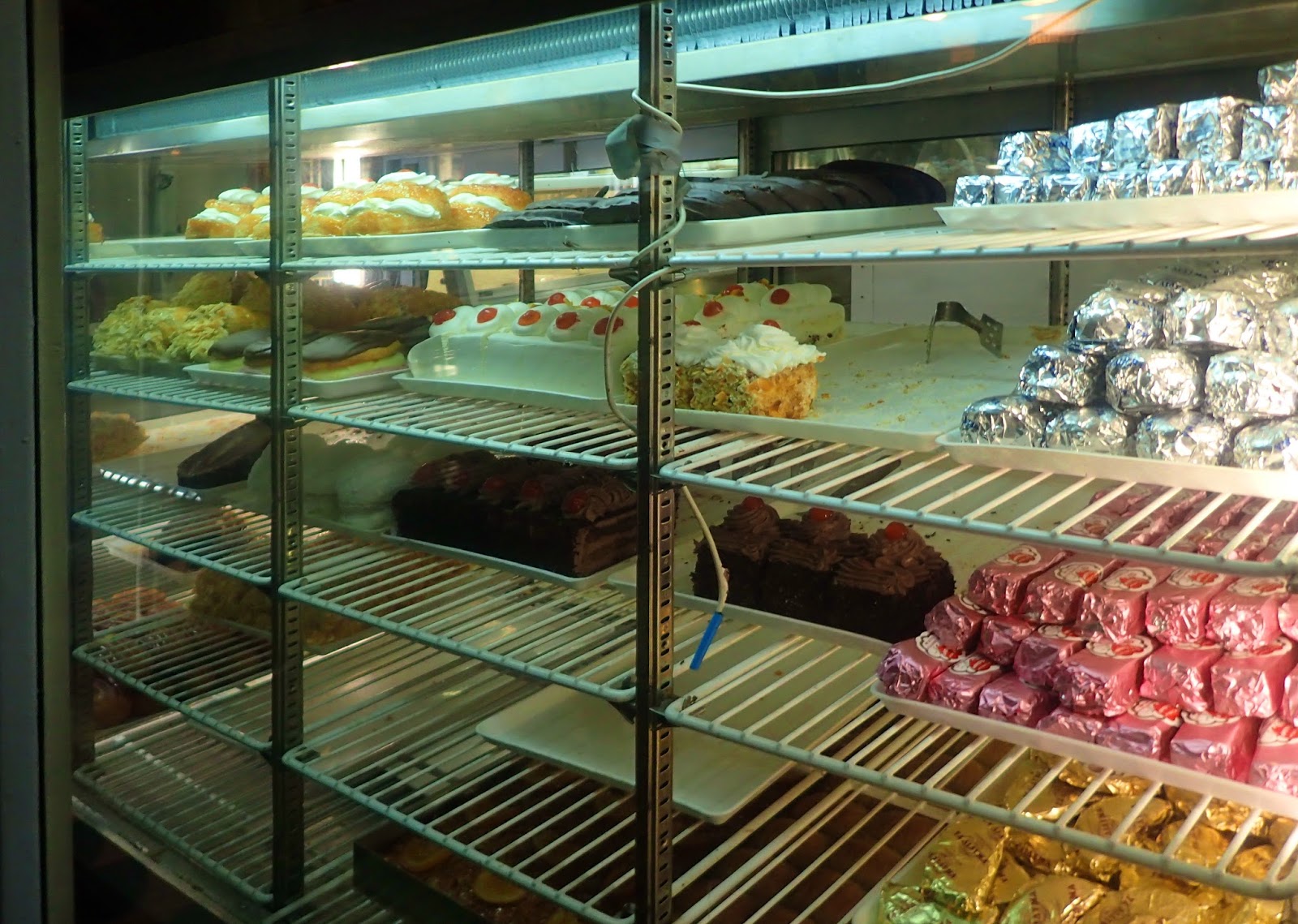
Our last stop is a favorite of all - the unassuming tiny Dorkada- right next to the Alaja Imaret on Kassandrou. Dorkada, family run for decades, is famous for sheep's milk yogurt with a thick skin of cream, and sheep's milk ice cream. The theme? If it didn't exist in 1957, you don't need it, hence the not at all large selection of perfect classic pastries. The ideal baba au rhum, fluffy cream cakes in white or chocolate, and the main syrup pastries all attest that modernity is overrated, sometimes completely irrelevant- a valuable truth in a city with such a rich, edible past.


Fresh, quality classics in the window display case at Dorkada
Thessaloniki Walking Tours make art (really, really entertaining art) out of history, the history tours every bit as delicious as the food ones. So far, I have been on the Rebetiko tour, the Ottoman history of Thessaloniki, been whipped madly around history and the Thermaikos at the same time on a fabulous sailing tour, and, out of town, the Footsteps of Aristotle in ancient Stagira. From each tour, I've come away knowing things that make single every day a little bit more interesting. I adore them. If you get a chance to go on one, do- it will add depth and dimension to your experience of the city.


Kinda Blue- Searching for the Roots of Rebetiko.


Read More »

Tuesday, March 1, 2016

Kinda Blue- Exploring the Roots of Rebetiko


The weather is just right- soft overcast skies that let that quiet kind of beauty flourish. It's no more strange that a prison would be photogenic than that mournful songs would be beautiful. What are we doing at the old prison on a Sunday morning? Musing on beauty, a lot of which came from here.

A group in our hometown (Thessaloniki Walking Tours) breathes the vividness of a fairy tale into the history and culture of our city. The tours I have been on are not so much walking and seeing (plenty of both) as they are like grabbing at a thread and following it somewhere unexpected, unearthing legends and memories along the way, visiting personalities so alive in memory and song that they are only technically departed, telling their stories, and in so doing giving layers of meaning to ours.   

The tour was about a genre of Greek music of deep cultural resonance- Rebetiko, in philosophy not unlike the blues, or American bluegrass, but distinctly urban. Its history is tied to the turmoil of early 20th C Greece, and like most genres with enduring meaning, it's not without darkness and strife. So logically we meet our guide, Tassos Papadopoulos, at the very prison that figures prominently in the culture of Rebetika, the storied Gendi Koule. It's the city's highest point, visible from everywhere, and with a grand vista. This was originally a fortress, part of the Byzantine walls. The main walls of the prison are themselves a rich mosaic- pieces culled from earlier structures- columns, plaques- casually and randomly incorporated into the walls. 


The more recent history draws us here- It became a prison at the end of the 1800's, and was in use until 1989 (!). Everyone on the tour remembers this as a functioning prison, a place of recent, vivid memory. It is hard to imagine that it could fall into such a picturesque state so very quickly. It is a moving place. Right inside the enormous gate is the visitors area. A double screen of mesh separates us from narrow walkways where our incarcerated friends and relatives would be. We could chat through the fine mesh, but not pass them anything- weapons, for instance, or more to the point, hashish. 

Visitors would be where the woman is, taking a photo-
Inmates in the narrow corridor that wraps around.

The Greeks who came from Asia Minor as refugees and during the population exchange brought a love of hashish with them. Illegal in Greece, it is not a jump to see how the prison fits into our picture. Rebetika itself was not in favor for the years of Metaxas- like the Nargile, it was thought much too Turkish.

Art born of melancholy has staying power. Also art born of contemplation. Rebetika casts a little spell- the repetition of a slightly plaintive, hypnotic motif takes hold of you. This is the characteristic "Moumourika," bringing you into the song and moving you forward with it.  A repeated motif makes all the sense in the world. As Tassos points out, in prison you have plenty of time on your hands.
We are crowded onto the platform suspended over one of the prison yards.
That is Tassos at the end of the walkway. Behind him, one of the cell blocks.
While we are on this narrow bridge stretched across the prison yard, Tasso is telling us some lyrics that came from here- Vangelis Papazoglou's song of 1935 "Five Years' Sentence". A man behind me answers him, and the song comes to life as a dialogue, back and forth across the length of the bridge. It is completely spontaneous, not unjoyous- a moment that reflects the depth of the integration of Rebetika into the collective psyche. We go back through the guard house and into the cell block, opened for us. This is the solitary confinement area, picture to the words of a poem about Genti Koule being "the tomb of the living"

We file out, contemplative, and outside the prison gates is a poignant, unexpected moment- two musicians have joined us

Nikolas Vezynias (guitar) and Yannis Eyinoglou (bouzouki) 
and we get to hear "Five Years' Sentence," right outside of the Genti Koule, and it's beautiful.

You could stop here, at this one perfect moment, but we don't- the history of Rebetika takes us through the city's spiritual landmarks.

We meander along the old walls to our next stop. It's near Tzo-Tzo's, a place for smoking and drinking and listening to rebetika songs being played at one table or another, maybe a decade long closed, no one among us has not had at least one memorable (yet blurry) late night here. It had the best view in the city, or at least that was the rumor- years of the rich smoke of hand rolled cigarettes had long blackened it out.

Right where we are standing is a ruin of a house, one of its walls the wall of the city itself. When the refugees came from Asia minor, they took the houses the Turks had abandoned, but it was not nearly enough. The Byzantine walls were covered with shacks and houses such that the wall itself could no longer be seen. A bulldozer finally leveled them one day, but left this one standing:


(Tzo-Tzo's is just out of the frame to the right. There's no more point in photographing it now than there was in eating there then. But it was glorious.) Tasso has lots of stories to tell us- we look over the west harbor, and the cranes disappear as he fills it with beer gardens and skating rinks, concerts, a tram- the pleasure gardens of Bechsinari (in Turkish "Besh" = five, and "Tsinar" the plane tree, so beloved for its deep shade). Just up from this in the marshes was the Bara- an enormous red light district of European-wide reputation. We hear the names of the old "Tekedes"- places to smoke hashish, and houses of cards and dice masquerading as tavernas- one, the Green Mill of the 1960's, right next to us.

As we zig-zag down through the enchanted alleys of Ano Poli, we stop at Tsitsani Square (merely formalizing the well-established immortality of Vassilis Tsitsanis), for some vignettes of his life-


The 16th C Tourbe of Musa Baba
In Terpsithea Square, next to the tomb of a Sufi holy man, we see photos and drawings that bring more of this rich subculture to life- we learn the different types of Magas (tough guy?), their arcane sartorial secrets. We imagine them walking through the square, maybe starting a fight. We learn single words that tell a whole story ("Dervishopaido," for instance- the ultimate compliment for one 'who dances like a dervish').

At the Alaza Imaret, we hear of an illustrious career, decades upon decades on all the continents- a life so full it seems like a myth, then to the cemetery for another life of mythic proportions. In the shade of the fountains by the Rotonda, one more tale- when we walk over to Alambra to hear more Rebetika, beautiful Rosa Ashkenazy still dances in our heads.


Thessaloniki Walking Tours cover many themes, and are also given in English. We have 17 centuries and three empires worth of history in Thessaloniki- they weave it into some fascinating, lively pieces. Visit their site for details-

http://thessalonikiwalkingtours.com/home/

You can hear live Rebetika several nights a week at Alambra, Phillipou 80, near the Rotonda.

https://www.facebook.com/groups/476296699057958/?fref=ts


Read More »

Sunday, December 27, 2015

The Lives of Others- Villa Bianca


The days before Christmas are usually filled with activity- holiday parties, shopping, preparations for all kinds of festivity. Between Christmas and New Year's, days take on another pace. Most of us still have a little more free time, and high-octane prep is out of the way. They are perfect for revisiting things that really matter, but seem to get lost in the happy chaos of day to day life the rest of the year. Catching up on cinema is popular, and in our own family, it was always a week of more museum going than usual. The tree at the Met, with the origami, was spectacular. This year's museum going has taken on a personal cast.


Right up the street we have one of those grand mansions that make you wonder who used to live there. It's a museum now. I've been a couple of times- for the architecture (Art Nouveau Gem!), the beautiful details:


and the story- a Jewish/Christian-Juliette/Romeo love story that was a juicy headline scandal at the time (with a happy ending- the elopement began a marriage of 50+ years.) An intimate space such as a private home is an idea setting for an intimate story. Grand works of art in grand galleries inspire, but life is not always about the Napoleonic wars- sometimes it is about love stories, long lost messages in bottles:

Did Aline Fernandez Diaz really write a message to Spiros Aliberti,
seal it in a bottle and toss it into the bay of Thermaikos in December of 1913,
only to be found over a hundred years later by artist (and winter swimmer)
Cynthia Gerothanasiou? 

(Truth should never be obscured by facts.)
the baths of children at nighttime in their nursery:

Dreamy bath of illumination by Maria Xinopoulou
and gifts the family Fernandez-Diaz presented with affection to their children's nanny, Euphrossini Papadopoulou, who cared for Jean, Robert, and Blanchette in the period between the wars:

Glimpse of the sweet value of sentiment by Katerina Rachmani
The afternoon was rich with imagination- a glimpse of beautiful things behind a closed door, and a chance to reflect on the treasured objects, tattered and splendid, that comprise our own sentimental lives.

The Villa Bianca is open Tuesday – Friday 10:00 – 17:00, and Saturday 11:00 – 15:00. 180 Vasilissis Olgas. (+30) 2310.427.555. Admission Free.

This charming exhibition is temporary. The exhibition galleries on the top floor- fabulous pitched roofs and ornate round windows- hold a permanent exhibition of religious icons, the likes of which you may never have seen. Open weekdays only.


Read More »