Showing posts with label Istanbul. Show all posts

Sunday, March 6, 2016

Celestial Agia Sophia- Intimacy and Awe


Nothing prepared me for the celestial height of the dome of Agia Sophia- not the skyscrapers I grew up with in Manhattan, not the Cathedrals of the West. The scale of Agia Sophia is at once majestic and human. It is not just vast: you feel the vastness, in the same way the stars on a moonless night at the beach make you humble. Agia Sophia is daunting, but still so intimate.

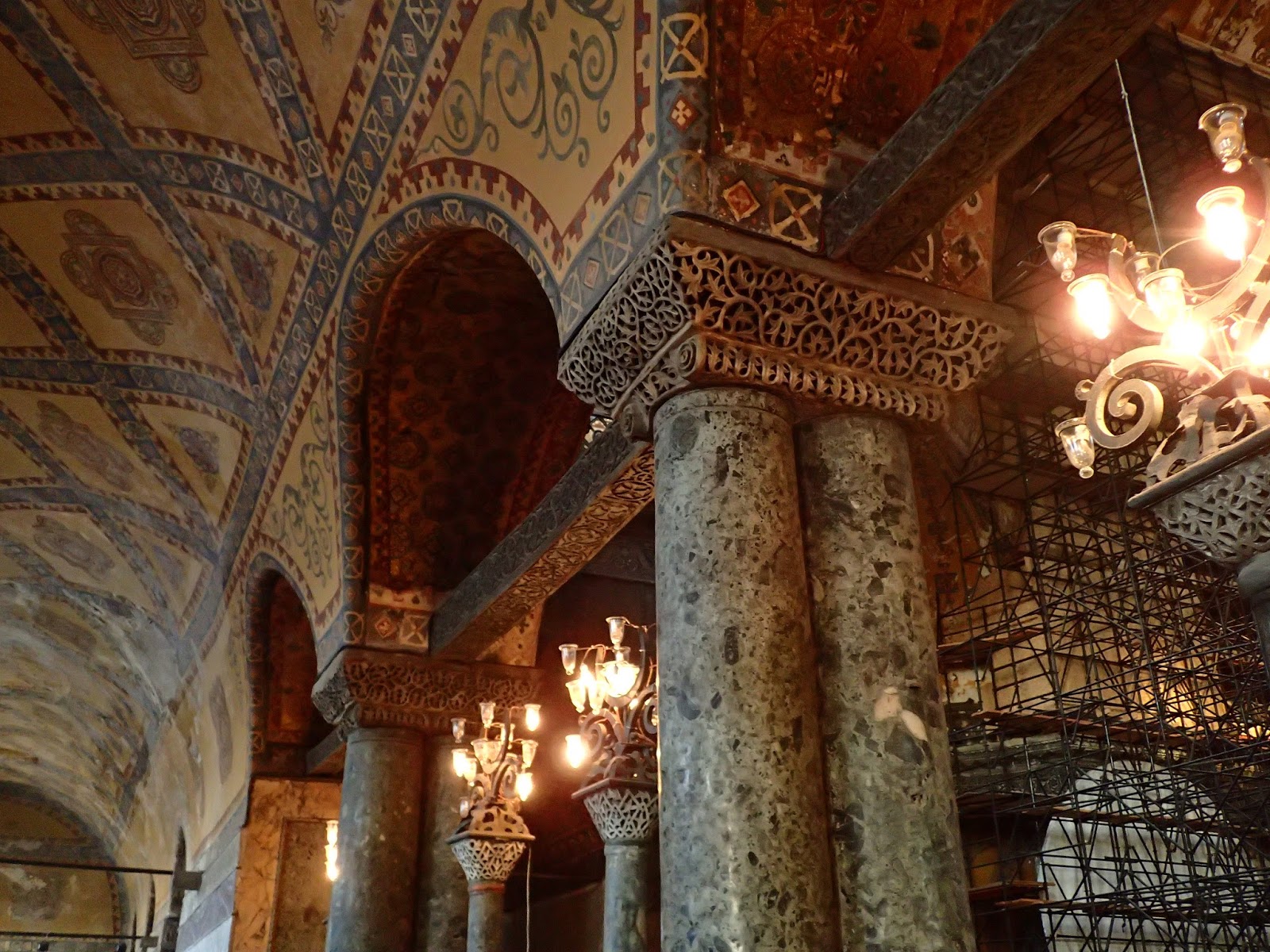
The 40 windows at the dome's base fill it with ethereal light, but can do little to illuminate the floor so very, very far below. There are other windows throughout the space, but the visitors' way is lit mainly by chandeliers. These are much less elaborate than those found in a Greek Orthodox Church -simple, elegant lamps arranged in a single plan in floral shapes.


They are hung at at  the distance from the floor they would be in a great ballroom. From above though, they seem just to graze the heads of the visitors, and this from the upper galleries, about a third of the way up.


The placement of lights breaks the space down into a comprehensible unit of human scale, serving to relate the visitor in size to the vastness of the whole. The doors leading in from the narthex are Alice-in-Wonderland "drink me" large-


Texture makes the space more palpable, less of an abstraction. There is a variety of moods: marble carved with the intricacy of lace:


And acanthus carved capitals top columns of patterned marble:


Folkloric painting adds accessible sweetness.

And tromp l'oeil "windows" acknowledge the mind of the viewer:


More tromp l'oeil surfaces, including nearly clumsy marble panels:


Celestial glory is humanized by tactile intimacy.

Just how high is it? Guide books give us a number- 55.6 m (182 ft). More relevant is the rareness of this experience of space. Notre Dame's nave, for example is 35 m. Supporting pillars define and segment the interior. The contemporary secular world is full of soaring hotel atriums- these may impress, but don't inspire, or daunt.Without the reminder of human scale and the palpable warmth of texture, space is an abstraction, a tribute engineering rather than to glory. Even in contemporary experience, Agia Sophia is extraordinary in its impact, joined by St. Peter's, the Cathedral of Seville, St. Mary's in Gdańsk . In the intimacy of experience, I found it unmatched.

Almost a thousand years would pass before a larger church was built- the Cathedral of Seville in 1506. This took over a hundred years to build (Notre Dame, nearly 200). Agia Sophia was built in just under 6 years, by 10,000 people. In 537, this must have felt like Heaven itself.


More things to love:


Read More »

Thursday, February 25, 2016

Jewelled Puddings of Istanbul


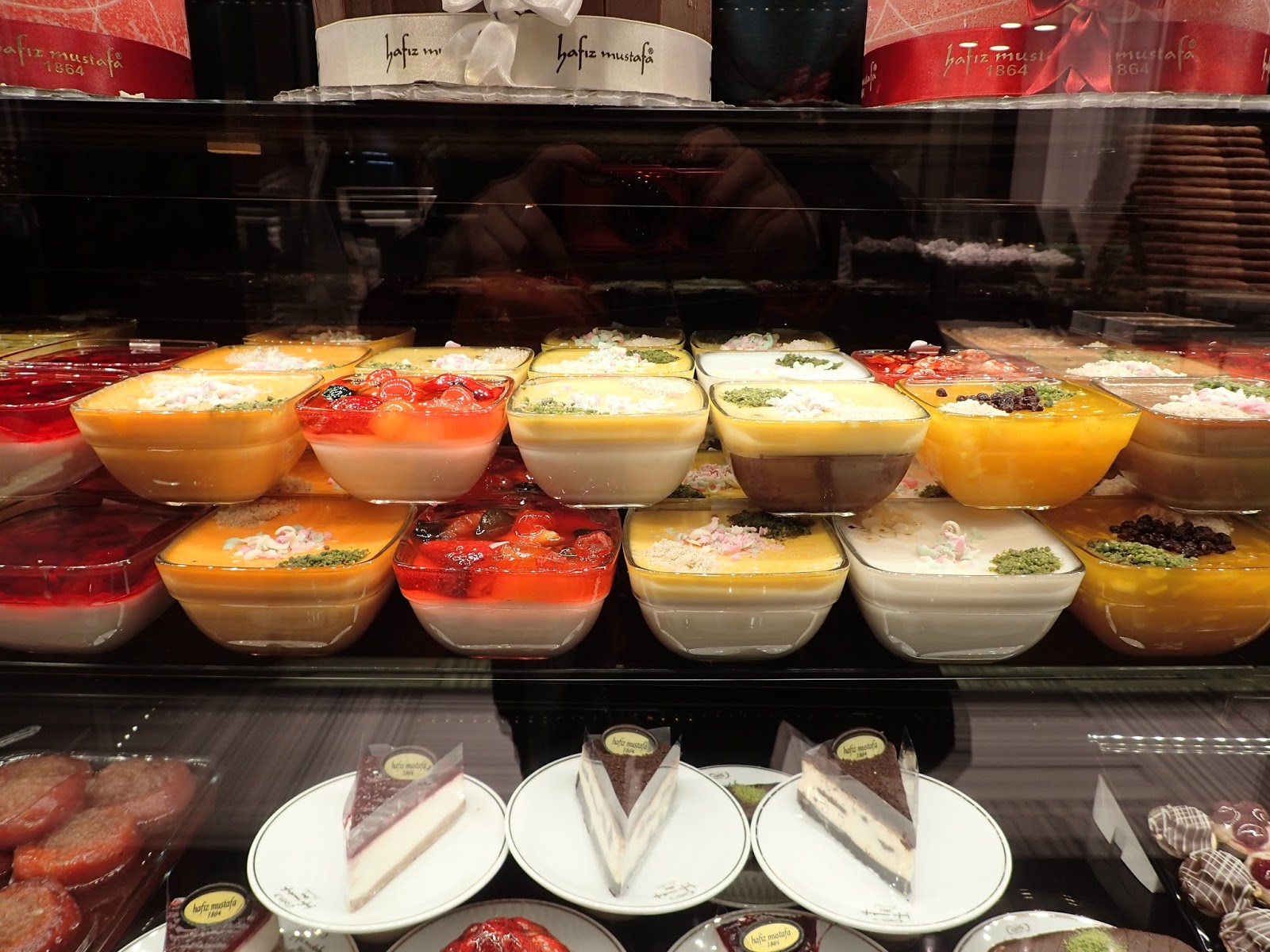
Jewell covered puddings fill display windows all over Istanbul. We were beguiled. And we did not manage to try them. If I had not taken pictures, I would think I am exaggerating them in my memory.

Unabashedly, unpretentiously pretty, they have the straight-forward simplicity of a dessert from  the 1950's

I have looked for recipes for these with no success, and in the meantime I found an incredible variety of Turkish puddings/creams. 


Until I learn otherwise, I imagine they are thought too simple to provide a recipe for- just a cream topped with a simmering, decorated jell. I would love to know more to make them properly, and will keep searching and experimenting. In the meantime, we tried our best, and loved the result inspired by the photograph.

The first batch we tried- chocolate with strawberry- was nice- but no nicer than pudding with jello. It needed more delicacy. The next batch we went with a white cream to show off the sparkle, and a jell with a much lighter set.

First prepare the fruit or nuts. We used sanguini here. You ant them to be ready so you can place them on the pudding before it forms a skin. If you lay them on top of the skin, they will float of the jell layer and the dessert will not have the jewel-like shimmer.


If it is something very juicy, like oranges, put them in a strainer.

Cream:
1 l/ 4 C milk
100 ml heavy cream
150 g/ 3/4 C sugar
60 g/ 1/2 C corn starch
a vanilla bean or some vanilla extract
a few drops of almond flavor

Simmer 3/4 of the milk, the cream, and the sugar over medium heat. Blend the cornstarch into the remaining cold milk, and when the milk and cream mixture is just before boiling, pour in the cornstarch mixture, whisking smoothly the whole time to avoid lumps. It will thicken nearly at once, but let it boil gently for a minute or two longer.

Arrange such glasses and clear bowls you have to show it off (it makes 6 - 8 good servings), and divide the cream among them, being careful not to get any on the sides and rims by using a ladle or even a wide-mouthed funnel. Arrange the fruit on top right away, and let it cool.


The Jell:

1 package commercial flavored gelatin in a color that suits your dessert
250 ml/ 1 C boiling water
500 ml/ 2 C fresh juice 

This is a much softer set- the package instructions call for just 500 ml of water. We used pineapple so the color of the sanguini would stand out. Now just pour the jell over the creams and carefully put in the refrigerator to set.


These are as much fun to sink a spoon into as a creme brulee, and the texture is wonderful- delicate jell, silky rich cream. Fancy and pretty and a like a grown up children's dessert.

If anyone knows the real recipe for these, I will be very grateful. This is just an affectionate interpretation, inspired by the beautiful window of a patisserie in Istanbul.


Read More »

Friday, January 29, 2016

Ten Perfect Things to Eat your First Day in Istanbul.


A fabled city is a 45 minute flight away from my home, and I had never been. It is so close, you always figure you can go whenever you like, kind of like the Chrysler building for New Yorkers. So I finally did, to turn my Mother's connection to San Francisco into a little holiday in itself. We had 48 hours- just enough to have the loosest of plans, with room to try everything. We left our beautiful little jewel box of a hotel at 3:30. By the time we got home after midnight, by luck far more than by design, we had tried these ten street food classics, and nothing but these. This really added to the pleasure- nothing that was not characteristically expressly Istanbul diluted the experience.


1. Kestane Kebab (Roasted Chestnuts)-

The two Charlenes standing in front of Agia Sophia, the Blue Mosque in the background
Agia Sophia closes at 5 in the wintertime- we don't like to rush, but we did not want to cram in everything the next day (given the next day's tragedy, we crammed in nothing at all but a reprieve so timeless it was surreal.). We were hungry enough it would prove distracting (I thought. In fact the Agia Sophia- curiously called "Hagia Sophia"- introduced to me first in my Smith College Art 100 survey, is so soaringly enormous that every sensation but sight is put on hold to take it all in, even then incompletely). Outside in the charming manicured plaza between Agia Sophia and the Blue Mosque are vendors with elaborate carts selling roasted chestnuts. Yes it could be Rockefeller center, or our own Aristotle Square, but as it turned out these are a truly Istanbul treat. In fact as time unfolded we saw roasted chestnuts everywhere, and always for the same price of 5 tl for the 200 g bag, just enough to stave the hunger of three. They were fat, sweet, easy to peel, As you see, the same stands sometime, but not always, sell roasted corn.

2. Dondurma (Ice Cream)-

Charlene getting faked out by the Dondourma guy

Turkish ice cream is like no other. Gelato gets its body from cornstarch, French ice cream from egg yolks. Turkish ice cream is bound from the pounded root of a wild orchid- salep- it is dense, sticky, stretchy. Fun to eat, and,apparently, fun to serve. They do this thing- since it is sticky and elastic they can pull it and twirl it around and spin it and move it from cone to cone and do little magic tricks with it and fake you out. A small cone- little bit of every flavor- was 7 tl, more than the chestnuts, and absolutely worth the show. It's also delicious, fun to play within the mouth.

3. Balik Ekmek (Fish Sandwich)

The man in black behind the cashier is actually on a boat-
that's where they grill the fish and make the sandwiches.
These are famous. We read about them in the Lonely Planet. Our friend told us about them, and the charming floating restaurants tethered to the docks by the Galata bridge. He said it is fun to go for fish sandwiches- a piece of grilled mackerel with some onions and lettuce. I said "that doesn't sound so great," and he said "no, it's not." and it wasn't- kind of fishy, lots of bread. But he was certainly right- it was fun to eat there, a covered garish and cheerful place with little low tables, and the fish itself grilling on a boat pitching to and fro on the choppy Bosporus. The sandwich- quite large, certainly as large as you would like- is 6 tl. There were some other visitors, like us, but local couples and families made up most of the crowd. A hidden bonus- the big bready roll makes you really thirsty, thirsty enough to try a cup of şalgam. 

4. Şalgam (Sour turnip juice)-


This bright red juice of fermented carrot or turnip or cabbage- we read different accounts- is sour, salty, a little piquant, and the plastic cup is jammed with pickles and crunchy leaves of pickled cabbage. Vendors outside the Balik Ekmek stalls sell it to the customers inside. The carts are elaborate and festive. Salgam seems like it would be an acquired taste and (salty and crunchy and sour, it's hardly a coca-cola) it is. But you acquire it right away- after that bracing first swallow you want more and more. We got another, and then later passing through on our way to the hammam, a third one to have as a post-sweat savory Anatolian gatorade. It was like nothing I'd ever, ever had. Şalgam redefines delicious and refreshing (2 tl).

5. Çay (tea)

That bowl in the foreground is filled with individually wrapped sugar cubes.
We love the grace tea adds to any moment in our household. It adds grace to seemingly ever hour in Istanbul too. Adding to the charm? The beautiful little glasses, tiny spoon, and individually wrapped sugar cubes. Our first of many cups of tea was on a random commuter ferry we boarded at Eminönü. A man circulated with a tray of hot tea (1,5 tl) and Sahlep, and long thin toasted sandwiches- a genteel, fully catered commute.

6. Sahlep-


The thing that gives the ice cream its body and chew also makes a hot drink. We have sahlep (salepi) in Greece too- viscous, a little yellowish, a little clear. I have never been crazy about it. Everyone said the salepi is different here and it was! Creamy and gentle and completely opaque white. A soothing drink. The thickness keeps it ultra-hot for a long long time. We just held the cups to warm our hands as we watched the passing banks of the Bosporus aglow in the evening light, breathing in the sweet scent cinnamon, until it was cool enough to drink. I would take a commuter ferry just have it again.

7. Osmanli Lokmasi- Loukoumades (hot honey syrup drenched donuts)


A town outside of Thessaloniki is famous for two things- loukoumades, and racism. There was this really unpleasant incident where townspeople did not want the kid with the best grades to carry the flag at the parade because he was from Albania. One of the small minded women was actually making loukoumades during the tv interview. So: the fact that some Turkish kids beat her hands down at loukoumades made us smile. As if we weren't smiling enough already. And these were even cold! They usually aren't worth eating cold. We got another, asked for a hot one this time, and gave ourselves over to the pleasure of the moment, completely wrapped up in this little plastic cup (3 tl) of bliss in the chilly evening, by the greenish fluorescent lights of the stand. We thought of getting a third, but got another turnip juice instead, so we would not be overcome at the hammam. I passed by a loukoumades stand at the agricultural fair today and they turned my head, but I wouldn't risk tainting the recent memory of perfection. Besides, it would have been unfair.

8. Sirma Lemon Soda
This was next to the soda- I didn't take a picture because I didn't know how delicious it would be. Here are some gorgeous '60's graphics,
and Aryan (like a buttermilk) in plastic foil-topped containers.
The best lemon soda I have ever tried. That is saying a lot- Greece has many small family run soda-pop factories and they all turn out delicious, zingy lemon sodas with lots of natural lemon juice. This one, with something on the label that said vitamin C, was cloudy and so thick with fresh lemon it was almost, but not quite, too sour. 

9. Döner kebab


We went to the hammam for the whole of the late evening. It closed at midnight, so we were happily hungry again. A few Döner places were still open.The man laid out one oblong thin bread and crossed it with another, added salad and a sauce of yogurt and mint that we could not get enough of, and wrapped it into a tidy cylinder where every bite has the right amount of everything. A dog followed us- we had to share it with him.


10. Pişmaniye


We got a box of this dreamy cotton-candy halva hybrid spun sugar toasted flour treat and ate it in bed in our hotel room after the hammam, washed down with sour turnip juice. We put balls of it in wine glasses and pulled off shreds with our fingers. From touch alone you would never think this is food- it feels like some gossamer insulation or packing material- dry, fluffy, delicate. You put wisps of it in your mouth and it melts on the tongue, leaving a lingering faint coating of richness from the roasted flour. Because of this flour, it is less sweet than cotton candy, so you can just keep eating wisp after wisp of it until you fall asleep, which is exactly what we did.


Istanbul's Urban Transportation is a delightful (and sometimes fully catered) adventure! More about that here. 


Read More »

Thursday, January 14, 2016

The Etymology of Everything that Matters to us.


I have all kinds of stuff to write about Istanbul, a city I woke up in for the first time in my life on one of its saddest days in recent times. I want to write about the best salepi- it's on a ferry going somewhere, I never knew where exactly, on the Bosporus. 


The best cup of tea was like a bouquet in a glass that Hussein made us as a treat at breakfast. I want to write about the Cemberlitas Hamam and the sweet lady who covered my mother in clouds of soap foam while we all chatted on the huge marble round. The ice cream guys do a whole thing spinning it around and messing with you.


Bright red sour turnip juice filled with leaves of picked cabbage and cucumbers is addictive- we got extra to have in our room to the revive our languishing blood after the hammam. 


The Kazan Dibi is so thick with salep (the powdered root of a wild orchid) that we could barely eat it with a spoon.


Somehow all of those things which are usually really important to me are not at the fore of my thoughts right now. We arrived in Istanbul on Monday afternoon and were just in time to see Agia Sopia at leisure and have Salep ice cream and roasted chestnuts in the great plaza. We could have rushed to the Blue Mosque and indeed thought of it- there was a good 45 minutes before evening prayers, but we did not want to see such beauty in a rush. As it happened, we heard the explosion the next morning as we were just finishing breakfast, not 250 m away.

You remember that song "It's Istanbul not Constantinople?" The name of the city is often shortened in Greek to simply "the city," (from "City of Constantine") as in- "are you in the city?" City = Poli, ("politics"), and in Greek, the root forms the words for culture and civilized- linking not just the word but the very place with the notion of civilization. That's a tall order. Here are a few of the things, really little yet super-important things, that make this city the crown jewel in the very notion of civilization itself:

Tea, and all it represents-

Tranquility, refreshment, and grace are taken at all hours in delicate, shapely glasses. Always a saucer, a perfect tiny spoon, and sugar cubes wrapped like present:


It's interesting when you travel to observe what things cost: A high cost could represent what something is worth, what people are willing to pay for it (pastry and confiserie were all over the place, and clearly deemed "valuable" - they were surprisingly expensive for us). A low cost on the other hand could represent that something is considered essential and must be available to all. Tea, always in a glass with a saucer and a spoon and these perfect little cubes, and often just 1 tl (about 30 cents), is such a thing. Even in the rushed atmosphere of the Grand Bazaar, this ritual is repeated thousands of times a day- tea vendors are all over, men swinging trays of glasses, going from shop to shop.

A beautiful public sink for handwashing between stalls in the Spice Bazaar
Hygiene-

This is a clean city populated by very clean people. Public hygiene, like tea, beautifies the city, like at this ornate public sink. It also takes the form of graceful ritual at the hammam. The one we visited, with a central platform large enough to accommodate a dozen women under its soaring dome, had been in continuous use for over 400 years. The ladies sang as they washed us (how old the songs are I could not say). 

Salepi on the ferry
Transportation-

Like tea, very inexpensive. And so practical. In addition to the metro, there are excellent trams and many, many boats (these are like well-appointed public salons floating to and fro on the Bosporus). Everything was gleaming; we even saw a man polishing the windows of the funicular while it was waiting in the station.


The best part? The commuters- always getting up for older passengers, and even moving so we could sit together as a group, trying to make room for everyone. There are seats that flip up when they are not in use to make room during crowded hours- people hold them down for others and motion for them to sit. One hears about grand Turkish hospitality- it extends to the public sphere. 

"Lady"-

You can refer to someone as a lady, but you cannot call someone "Lady" in American English- it sounds ironic. But the way they say it in Istanbul, it is like a "Madam" without the pretension and over-formality, and so much sweeter than "M'am." I have never been called so sweetly in any other city.

Istanbul is crowded- full of life and action and noise. But then there is tea, and cleanliness, and it is so easy to get around. People call you "Lady" in a kind voice. Most of all, the citizens set the tone: such gracious civic behavior, everyone seeking an opportunity to accommodate others: mindful, thoughtful, the very definition of civilized. 


How did we get into the city? Very easily- and the charming Urban Transport turned out to be a destination in itself- Here's more about that.


What to eat while you're there? Here are 10 perfect streetfood experiences we had on our first day


Read More »