Showing posts with label Tea. Show all posts

Monday, June 27, 2016

Tea Time at Eumelia


Roosters are impatient. The stars are still twinkling softly, but every five beats or so they cry out, sweet and melancholic like a muezzin, so it must be tea time, whatever the sky says. 


I have no tea.

This is my first morning at Eumelia, a bio-dynamic, organic paradise that combines farming with philosophy (and fine living), one of those philosophies being that the earth is burgeoning with a wealth of beauty and of food, and it's often best to accept what it has decided to give us, and sometimes, to let ourselves be surprised.

A pre-dawn frolic
I'm greeted at the door by a bevy of dogs, and the roosters are still at it. The cicadas won't be singing for another hour or two, but there are swallows and sparrows. The sun is not up, but it seem like everyone else is. We make our way to the herb spiral under a pale cool sky to find something to make tea with. 


And we all find everything we need- some rough mint, lavender blossoms, wild fennel fronds for me, and my camera for the dog - he thinks I will chase him for it, and he's right. 

The sky is gold but the sun hasn't cleared the hill. It is around 6:30. Before making tea I want to see the roosters (they're not at all hard to find - they're still at it).


They're indoors. They must have an internal clock - there would be no ebbing of night to be seen from in here. (If you are an urban person like me, you may be surprised by their size- nothing to do with a dressed supermarket chicken, plus feathers. You could hold but one of them cradled in both arms, and if you needed to hold two, you would have to hang them from their feet. I would do neither- they look redoubtable.) I also see someone else in the barnyard- someone fabulous. I am saving him for another post.


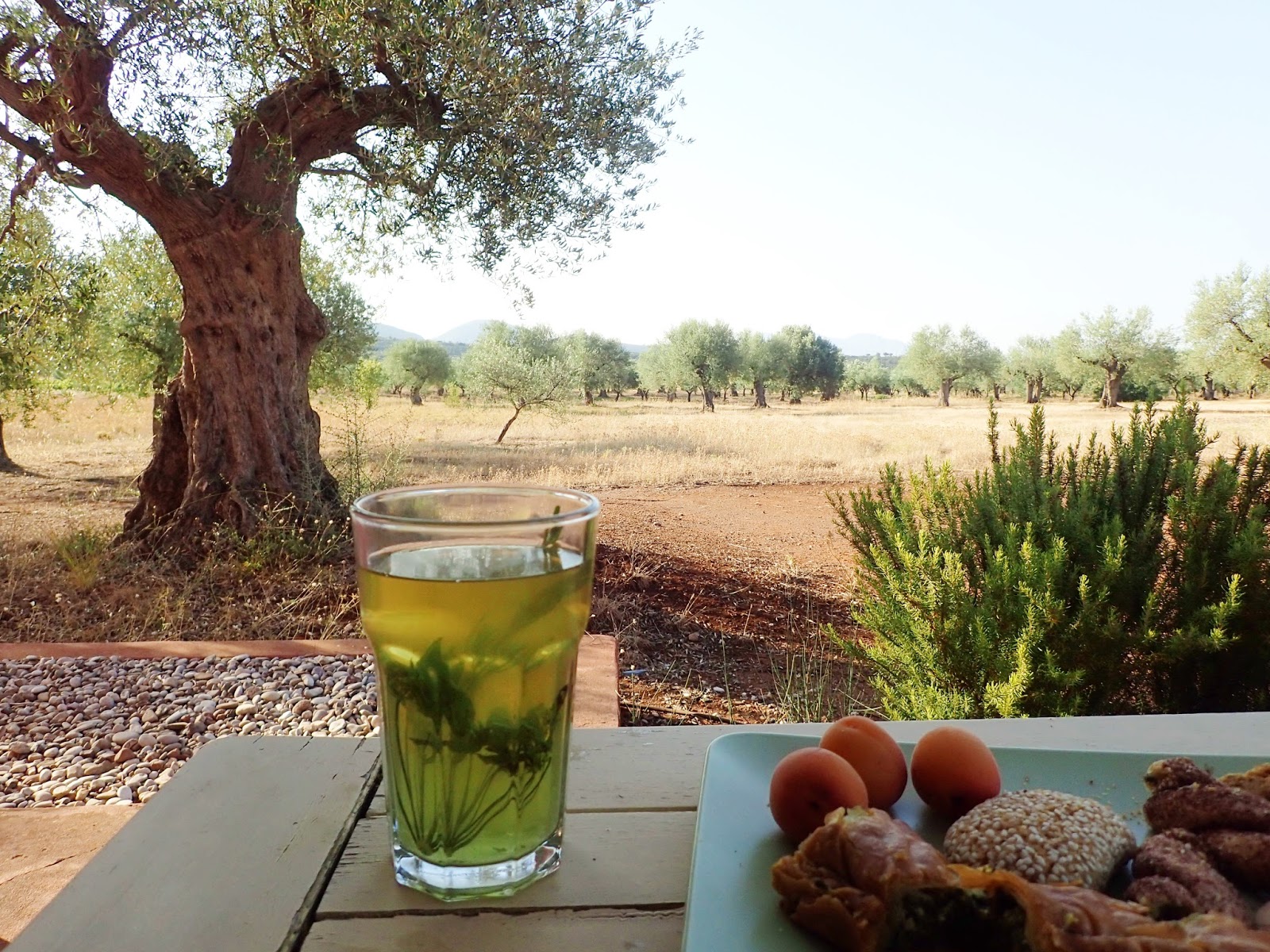
There's a weathered table in front of the bungalow- I toss the herbs here and put the water on to boil. Then I give them a rinse (they are organic but there is still dust, and dogs) and crush them gently to free up the aroma. The scent is so fresh and so strong I'm afraid it will wake up my friend Janet. Just as I pour the water over them, the first rays of dawn hit the trees.


An olive tree behind our bungalow has seen over a millenium of sunrises. I want to see how it likes this one-


The tree, majestic at any hour, glows in the first rays of dawn.

The tea is perfect.
__________________________________________
More Experiences at Eumelia:


Five things I learned at the most delightful wine tasting ever.


A glamorous drive to Gytheio


A completely different tea experience:


Drinking Chai on Evripidou.
Read More »

Thursday, January 14, 2016

The Etymology of Everything that Matters to us.


I have all kinds of stuff to write about Istanbul, a city I woke up in for the first time in my life on one of its saddest days in recent times. I want to write about the best salepi- it's on a ferry going somewhere, I never knew where exactly, on the Bosporus. 


The best cup of tea was like a bouquet in a glass that Hussein made us as a treat at breakfast. I want to write about the Cemberlitas Hamam and the sweet lady who covered my mother in clouds of soap foam while we all chatted on the huge marble round. The ice cream guys do a whole thing spinning it around and messing with you.


Bright red sour turnip juice filled with leaves of picked cabbage and cucumbers is addictive- we got extra to have in our room to the revive our languishing blood after the hammam. 


The Kazan Dibi is so thick with salep (the powdered root of a wild orchid) that we could barely eat it with a spoon.


Somehow all of those things which are usually really important to me are not at the fore of my thoughts right now. We arrived in Istanbul on Monday afternoon and were just in time to see Agia Sopia at leisure and have Salep ice cream and roasted chestnuts in the great plaza. We could have rushed to the Blue Mosque and indeed thought of it- there was a good 45 minutes before evening prayers, but we did not want to see such beauty in a rush. As it happened, we heard the explosion the next morning as we were just finishing breakfast, not 250 m away.

You remember that song "It's Istanbul not Constantinople?" The name of the city is often shortened in Greek to simply "the city," (from "City of Constantine") as in- "are you in the city?" City = Poli, ("politics"), and in Greek, the root forms the words for culture and civilized- linking not just the word but the very place with the notion of civilization. That's a tall order. Here are a few of the things, really little yet super-important things, that make this city the crown jewel in the very notion of civilization itself:

Tea, and all it represents-

Tranquility, refreshment, and grace are taken at all hours in delicate, shapely glasses. Always a saucer, a perfect tiny spoon, and sugar cubes wrapped like present:


It's interesting when you travel to observe what things cost: A high cost could represent what something is worth, what people are willing to pay for it (pastry and confiserie were all over the place, and clearly deemed "valuable" - they were surprisingly expensive for us). A low cost on the other hand could represent that something is considered essential and must be available to all. Tea, always in a glass with a saucer and a spoon and these perfect little cubes, and often just 1 tl (about 30 cents), is such a thing. Even in the rushed atmosphere of the Grand Bazaar, this ritual is repeated thousands of times a day- tea vendors are all over, men swinging trays of glasses, going from shop to shop.

A beautiful public sink for handwashing between stalls in the Spice Bazaar
Hygiene-

This is a clean city populated by very clean people. Public hygiene, like tea, beautifies the city, like at this ornate public sink. It also takes the form of graceful ritual at the hammam. The one we visited, with a central platform large enough to accommodate a dozen women under its soaring dome, had been in continuous use for over 400 years. The ladies sang as they washed us (how old the songs are I could not say). 

Salepi on the ferry
Transportation-

Like tea, very inexpensive. And so practical. In addition to the metro, there are excellent trams and many, many boats (these are like well-appointed public salons floating to and fro on the Bosporus). Everything was gleaming; we even saw a man polishing the windows of the funicular while it was waiting in the station.


The best part? The commuters- always getting up for older passengers, and even moving so we could sit together as a group, trying to make room for everyone. There are seats that flip up when they are not in use to make room during crowded hours- people hold them down for others and motion for them to sit. One hears about grand Turkish hospitality- it extends to the public sphere. 

"Lady"-

You can refer to someone as a lady, but you cannot call someone "Lady" in American English- it sounds ironic. But the way they say it in Istanbul, it is like a "Madam" without the pretension and over-formality, and so much sweeter than "M'am." I have never been called so sweetly in any other city.

Istanbul is crowded- full of life and action and noise. But then there is tea, and cleanliness, and it is so easy to get around. People call you "Lady" in a kind voice. Most of all, the citizens set the tone: such gracious civic behavior, everyone seeking an opportunity to accommodate others: mindful, thoughtful, the very definition of civilized. 


How did we get into the city? Very easily- and the charming Urban Transport turned out to be a destination in itself- Here's more about that.


What to eat while you're there? Here are 10 perfect streetfood experiences we had on our first day


Read More »

Thursday, October 1, 2015

Double Greek Coffee Meringues- for International Coffee Day.


Actually, every day is coffee day in Greece. Ours is happily a nation of delicious and inventive coffee drinks. As in so many other nations, the word is nearly synonymous with socializing.

But two iconic coffee drinks differentiate Greek coffee drinking from that of European neighbors. The first is, of course, Greek coffee- finely ground to a powder that is blended together with the water and what in every household is understood by the word "coffee." This is what is known more commonly throughout the world as (sorry) Turkish coffee. 

Greek coffee has a lot going for it:

skill- preparing it well and giving it the characteristic dense and subtly grainy head of kaimaki ("cream") takes a practiced hand. There is precision to the heat and the timing.
rustic, minimal equipment- a simple portable mini camping gas burner is part of every household;
craftsmanship- you can buy a selection varying sizes of beautiful specially designed brewing pots with a long handles, hand made by metal smiths.


ritual and lore:  In all other types of coffee extraction methods, the grains just go to waste. In Greek coffee, they foretell the future: looking for signs and symbols in the patterns left by residual thick grains in the overturned coffee cup is a traditional skill so back in vogue that many coffee shops advertise the service. (Also, a little coffee accidentally splashed on the saucer? - Good luck- money is coming to you.)

There is an elegance in this elemental drink- coffee, water, heat- to which is added only craftsmanship. There are no filters, no percolators, no steam extractors. 

On the opposite end of the spectrum of tradition and craftsmanship is the other main coffee of Greece: instant coffee- Frappe if cold, "Nes" (short for the most popular instant coffee brand) if hot. This is served everywhere- elegant cafes have "Nes" on the coffee menu, right next to the cappuccino and the cafe au lait, and they bring it, whipped into a froth, in fine china cups with a tray of biscuits on the side. Every kiosk sells the makings of frappe- a bag containing a plastic cup with a shaker top, an individual serving envelope of nescafe, and 2 sugars. You can get a high-end Frappe too- it is even on the menu of the legendary and splendid Hotel Grande Bretagne (really- I just checked). Instant coffee granules whipped into a froth with cold water and some sugar and canned (never fresh!) milk added is surprisingly tasty.

These super-easy Baroquely gorgeous meringues pay tribute to Greece's two most popular coffees. There is no getting around the high sugar content of a meringue- it is what stabilizes them and gives them their lasting structure. The rich aromatic bitterness of coffee in these goes a long way to cutting the sweetness. You will never have had a meringue with a more balanced flavor or elegant appearance, free of the sugary bam and the blinding whiteness (nothing against weddings and baptisms....).

These will take you about 15 minutes, cost you about 75 cents, and for that will cause all kinds of fuss piled high on a pretty tray. 

We will need:

4 egg whites
200 g/ 1 C white sugar
a dash of salt
2 tsp. of instant coffee dissolved in 1 tsp. of vanilla extract (homemade here) or whiskey or rum (or water if it must be)
2 tsp. of Greek coffee
1. Beat the whites with a dash of salt until frothy and begin adding the sugar, spoonful by spoonful so that it has a chance to dissolve, beating all the while. A dense, glossy meringue will form in about 5 - 8 minutes.

When they whip up to a stiff peak they will hold their shape beautifully.
 Keep checking so as to not over beat- they could toughen.
2. Add the diluted instant coffee and blend:


3. If you have a pastry bag and a tip, pipe them into decorative swirls onto a baking sheet lined with non-stick baking paper. Otherwise shape them as you like with a spoon- they will hold their form beautifully(!). Keep in mind that they will swell a little in the oven. Dust them with the powdered Greek coffee:


4. Bake them in a very slow oven, 100 C/ 215 F - 120 C/ 250 F- check them- if they oven is too warm they will take on color, which we don't want. They dry as much as bake, and will take at least an hour to do so. We need them dry only on the outside, such that they can be easily and cleanly lifted from the paper. A little melting softness on the inside is nice. 

Success is assured on a dry day, but making them in the heavy rain could try your patience. They would be excellent sandwiched together with whipped cream (not very sweet).

(Ironically, we serve them with tea):


Read More »

Monday, March 23, 2015

Constant Comment Tea is its own 'Madeleine'. Plus, a Golden Wealth of Scraps.

Even in our season of Lent, it's hard to advocate virtue in the kitchen. Kitchens run on vice- cravings and longings and greed. Turning a lustful eye to kitchen scraps does them more favors than thrift ever will- maximizing the possibilities for every kind of pleasure is what kitchens were made for.


While rinsing that single fork as yesterday's cake was in the oven, I looked around the kitchen for anything that might enjoy a little heat, either alongside the cake or to soak up the soft heat of the turned off oven after it was done. Sometimes there is a handful of tired almonds to revive, for instance- a dish of hot toasted almonds nearly always leads to the opening of a bottle of wine  This time, I found a half bag of dried coconut:


What fragrance this has lost will be found again as it toasts- 
then it will get tossed over curries,
and have some rich golden macaroons made of it.
hunks of stale bread to make croutons for Caesar salad (to have as we watch an episode of Mary Tyler Moore- a favorite lunchtime ritual), and a bowl of oranges on the counter, flesh ready for juicing, rind leftover to make a tangle of wide strips of zest:


Orange zest when cooked fresh takes on a paradoxically unfresh musty flavor. Dry the zest and the fragrance stays juicy and lively- this is as true for Chinese orange chicken as it is for Constant Comment tea:

favorite of our great favorite- great grandmother Mercedes Davidson,

Shown here in 1966, with me cooing at her.
Her pleasures included this tea, magnificent flowers,

strictly benevolent gossip,
and being deliciously scandalized by bawdiness.
(and therefore my own favorite too), and easily made with twists of dried orange peel and a few whole cloves steeped with loose black tea:

I could never, like Proust, pick a single taste to be my own madeleine, but this tea is one of them.


Reminiscence, perfumy hot tea, a classic Caesar salad with equally classic 70's television, and- soon- chewy golden macaroons. All this from the prudence of vice and the gentle waning heat of the oven. One pleasure seems always to bring another.


Read More »

Monday, September 22, 2014

Drinking Chai on Evripidou


আপনার সাথে পরিচিত হয়ে খুশি হয়েছি৷


That's "pleased to meet you." in Urdu- above, and Bengali- below- turn the corner off of Evripidou and the only thing in Greek is the street signs themselves. I really was pleased! 


The word cut off at the top is φελλοι- corks. This is a shop selling corks,
  jugs and barrels for wine and oil, and rope- all you need for the serious pantry.
After this most Greek of shops, one abruptly enters a little slice of Lahore.
Of course the architecture is the same, but that is all. Even if you are not noticing the limes replacing the lemons and the crazy pretty bumpy bitter melon spilling out of cardboard boxes,
Beautiful bitter melon!
and the shop signs in Urdu and Bengali, and the saris twisting in the breeze outside of basement shops- vivid color everywhere- you can sense the change of neighborhood from the rich scent of heat and curry. And of course, everything sounds different- fluid and mellifluous, and: no yelling. Grace to the ear. I'm here by accident- truthfully, not ten meters from the site of a recent post- ironically advocating pork and hard liquor before 11 am ("Let's meat for breakfast.")- but the neighborhood is well-known. Having said that, no one Greek is here.

Pommegranate molasses, coconut milk, dal. No feta in sight.
Cell phone repair shops are not usually on my (hedonistic) radar. But they are all over the place here- outnumbering barber shops at 4 : 1  (there are lots of barber shops), and I decide to drop off my beleaguered phone for a fix up, and go for tea.


This would seem simple. I know the pastry shop with its glamorous technicolor merchandise in the glass cases.

South Asian sweets are delightful!
My favorite is bright green sandwich rich with a soft fresh cheese.

I ask for a chai. But they serve no hot drinks. The gentleman comes out from behind the counter to indicate a shop down the block and across a large road. As soon as I get across the street, a young man emerges from another cell-phone shop, asking if he can help. I tell him no thank you, I was looking for tea. "Yes, I know that. The man from the bakery just called ahead." This delights me. He shows me to the Greek snack bar next door and I'm thinking "Oh that is so nice- the Greek coffee shop has adapted its menu to its new customers." Then I order a chai. To this, they answer "Tsai?" and pull out some foil-wrapped bags of lipton green tea. Also, there is no milky exotic steam in the air. Alas. Back at the cell phone shop, the man is happy to hear that I really do want chai- sweet, spicy, milky chai- and directs me to a tiny deep pink restaurant with large photo of Mecca on the wall. I am comfortable with my large shawl already about my shoulders (usually it serves me in Orthodox churches), and served with warmth.

Does he have a sweet? No- but with my super-hot, super-sweet, super-milky spicy tea, he brings me a plate of hot basmati with bright green and bright orange tinted (and flavored?) grains of rice scattered throughout like confetti. It is buttery and rich and heaped with sugar that quickly melts in. So hospitable! I learn that the gentleman has been to Mecca and looks forward to going again, and that he has been in Athens for 12 years. 

There remain another 20 minutes before I might pick up my phone. Happily some colorful garments beckon me down the stairs to a basement wholesaler- saris, kaftans, and tourist dresses with meanders all over them like you see at the shops in Plaka. I get a butter pink kaftan for my next visit.
The fluorescent basement was stacked with
fresh-looking cotton garments
and smelled of incense 

Street poetry flourishes- as it of course must-
without a shred of regard for the modesty of its neighbors.
The man at the cell phone shop asks if I minded the wait and I said no, as I have had a fine cup of tea. He follows my gaze up the street and says- "Oh he's my cousin. We came together twelve years ago." I'm glad I didn't ask him in the first place- I'd have missed so much.

Chai:


To make chai at home, just chop up a lot of fresh ginger, and crush 7 or 8 cardamom pods, and add them to a liter and a half or so of water, along with perhaps ten black peppercorns (don't worry- you need some heat to absorb all the milky sweetness) and a whole clove or two. Boil a while to let the depth of their flavors come out and add some milk and some sugar and a couple of spoons of loose black tea or 3 or 4 tea bags, and a stick of cinnamon.This is really the only helpful thing I have to say about making chai- when cinnamon steeps for any length of time, its bright sweetness is replaced by an over-boiled mustiness, so add it soon before drinking, not at the beginning- you just want it to open up like a flower. I think it is best if the chai ends up being slightly darker and milkier and sweeter than western tea (even for those who like their western tea deep and sweet and milky, as I do.). You'd think it would be just the thing for fall and I suppose it is, but I really love it scalding hot in the deep shade of summer.


Read More »