Showing posts with label Easter. Show all posts

Friday, April 29, 2016

The Best Good Friday


Good Friday is the best holiday of the Easter cycle. The Resurrection- pinnacle of the season- is for most of us fleeting- we join the crowd filling the streets around the church, receive the light, break eggs, and kiss a lot of cheeks. It's joyous, but so brief. Mageiritsa is waiting.

Good Friday is- technically- not joyous, and certainly not brief. Bells of mourning have been pealing at measured intervals all day. The stores open around noon so everyone has time to kiss the epitahio. After sundown, the church fills up again- to kiss the epitaphio if you haven't already- and then to file out of the church to join the procession around the neighborhood.

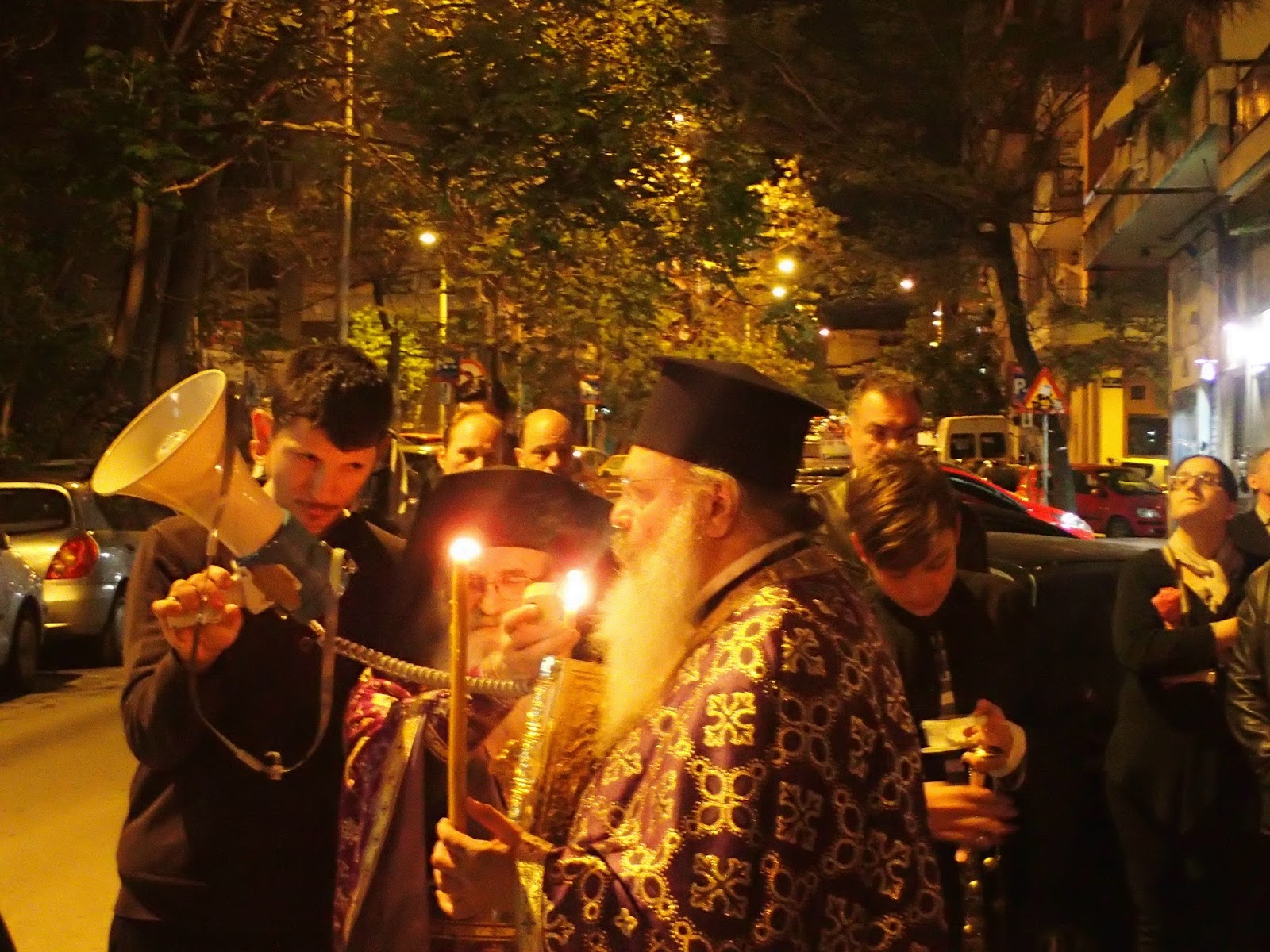
For a couple of hours, the city transforms. Decked out altar boys-


priests with megaphones under the golden streetlights-


and the blossom covered Epitaphio followed by the congregation make their way through the streets, 


navigating through the parked cars. 

At the lager churches, a military marching band joins the procession, and so do the scouts-


Everyone's holding candles, also form the balconies above, and as solemn an occasion as it is, there is joyous anticipation. The flags are at half mast now-


But we will all be back here tomorrow night for the church's most joyous, light-filled moment of the year


to say Χριστός ανέστη (Christ has risen), and Κάλο Πάσχα (Happy Easter), take the light back with us into our homes, and feast with joy.

Read More »

Wednesday, April 27, 2016

The Fragrance of Easter


Greek Easter is a season, not a day. Clean Monday- the beginning of Lent- starts the long build-up from the the season of naked branches to the season of leaves the size of children's hands. The last of the apples, a little withered, give way to the first strawberries, as nature illustrates the spiritual rebirth. The most solemn week of the Christian calendar is, in truth, brimming with joyous anticipation.


Palm Sunday brings the welcome taste of fish- those who have been observing the Orthodox fast have had nothing of creatures with blood- no meat, dairy, eggs, or fish, eating only seafoods, vegetables, olives, oil and bread.


Holy week, the fast resumes, with many from Wednesday on taking no oil, and some from Good Friday fasting altogether. Of course, alongside the fast, joyous preparations begin.

Tsoureki fresh this morning at our neighborhood bakery "Thoma"
The Easter treat is tsoureki- a sweet, eggy bread rich with butter- not unlike challah or babka or kulich.  Depending on the region and the household, it will be flavored various ways- mahlepi, the inner seed kenel of the pit of a certain cherry (like noix from the pits of apricots) is classic- it is said to taste like cherries and bitter almond, but to me it smells much more mysterious- and a little musty- like incense. Others use mastika, the dried resin of a wild pistachio tree that grows only on the island of Chios (the source of our verb masticate)- it looks like a crystal and tastes like a forest.

Clockwise from 7 o'clock- mahlepi, cardamon, and rocks of mastika.
You can buy great tsoureki, but then your house will not be filled with the scent of Easter. The dough is satisfying to knead and fun to braid and twist into shapes. A child, covered with flour and standing on a chair next to a patient grandmother, can usually be called on to help with this. Tsoureki bake astonishingly quickly- a moment too long and they are dry. Tsoureki should be moist and pull apart into long strands, the mark of thorough kneading. I would gladly share a recipe with you, but I am still searching for the right one.

Ingredients for tsoureki, including a special flour
The same day, commemorating the crucifixion, we dye eggs truly deep blood red- a color you can only buy in markets that sell things to Orthodox communities. No amount of food coloring will get the effect. The eggs will be polished lightly with oil, and whatever are not braided into the tsourekia will be displayed on the table, to be brought to Church for the resurrection on Saturday night. The dye needs lots of vinegar- simmering with the dye it fills the air. Like the smell of tsoureki baking, you can tell it's Easter with your eyes closed.

Good Friday on an island must be wonderful- friends tell me that when they were girls they would gather the day before to decorate the Epitaphio with flowers. I don't know who prepares the Epitaphio in the city but, they are covered too, flowers woven all over the frame and canopy. In the evening, people gather at every church to follow the epitaphio though the streets in a procession. All along the way people come out onto their balconies with candles. Sometimes two processions meet- In Thessaloniki, the Epitaphia of Grigoriou Palama and Agia Sophia meet at the intersection of Agias sophias and Tsimiski. The altar boys are little guys; they get bored waiting- once two of  them ended up on the ground, horsing around in their elaborate robes. The nun was cross.

The next day is madness- all last minute gift shopping and hair salons, mageiritsa cooking, and buying lambadas- candles to receive the light of the resurrection. What's mageiritsa? You'll probably know there is usually a whole lamb (or goat) roast on the spit for Easter Sunday. the organs are wrapped into tight bundles with the scrubbed-clean entrails to make this traditional Easter Soup- these bundles simmered in an egg-lemon broth green with fresh herbs. This is the soup to break the fast after the resurrection.

Sometime after 11, the churches and and grounds and streets around them fill. We're all dressed up, and some of us not necessarily modestly (after church is mageiritsa, and after mageiritsa- bouzoukia). Around midnight the bells toll and the light of the resurrection spreads from the church through the crowd, the scent of flames and melting beeswax fill the air as one candle lights another, a joyous moment.

Technically it's not the mageiritsa that breaks the fast- that is the first meal. But the first thing we eat? The eggs- we have all brought red eggs from our homes. and not just any red eggs- everyone has chosen their own egg, the one they think has the best chances against the other eggs- we crack them against one another, end to end, the aim that your egg stays intact. And now it's mageiritsa, the whole family around the table. No one will be in bed before 1:30 or 2 tonight, not even the children, and many of us will not go to bed before the sun rises on Easter morning.

More on Easter:

Imam Biyaldi- perfect for Holy Week


Marble Eggs from onion skins


Ricotta Pie Esperdy (for a taste of Easter in Manhattan)
Read More »

Sunday, March 27, 2016

Last-Minute Easter Desserts


Happy Easter! It has taken me by surprise entirely. Orthodox Easter is usually later, but rarely five weeks later- we are just barely into Lent. If the Holiday has also come up sooner than you had planned for, there's still no reason to go without dessert, and a very glamorous, festive one.


Pavlova dazzles- lofty, creamy and light. Rustic meringue shaped with the back of a spoon, some poached fruit, and Baroque heaps of whipped cream. 4 ingredients (plus a little whiskey or rum?)


Can a cake be a turning point in your life? This one was for me- I have been making it since I was 13 and got a cookbook by Maida Heatter, thereafter my mentor and guardian angel in all things sweet. Toulouse-Lautrec cake is so simple that you can make it on a tv show, mess it up by forgetting 2 of the 5 ingredients, and it will still come out perfect (I did- that's what the photo is from). 


We make these very simple meringue mushrooms to decorate our Bûche de Noël. On their own, they are full of whimsy, perfect for the Holiday, and a delight for children and everyone else. If you have no block chocolate, melt a couple of chocolate eggs to glue them together.

Lenten Chocolate Cake-


Perhaps you've already boiled and dyed all the eggs in the house? Borrow this delicious, moist chocolate sheet cake with a fluffy light texture from lent. Mix dry ingredients straight in the baking pan- no bowl needed. Add water, oil, and vinegar, stir with fork, put the cake in the oven, and the fork in the sink when you're done. And you're done. 

Read More »

Thursday, April 9, 2015

Imam Bayildi- Melting Sweet Eggplants for the pre-Easter Table.


The tender, yielding, mouth pleasing richness of texture is described in Greek as "λουκουμι"- loukoumi- what we know as Turkish Delight (a name which, in turn, is semi-jokingly called an oxymoron by more conservative English-speaking Greeks). Meats- slow roasted or gently braised ("melt in the mouth") dishes- are often called "loukoumi," and so are these magnificent melting eggplants, stuffed with sliced onions that are themselves nearly falling apart, sweet and fragrant. They really are a Turkish delight- known and beloved in all the neighboring countries as well, prepared as if their own. It's ideal for the Orthodox fast, and for vegetarian and vegan friends. and it is beautiful on the table- those paisley shaped eggplant halves and the golden onions in their orange oil glitter like gems. 

Oil elevates the humble ingredients. Like with our other oil rich dishes- green beans in oil and tomato, cuttlefish in wine- you need a lot to get the desired oil-bathed tenderness, but the excess floats free of the dish (tinted and richly scented with the best notes- you could just ignore it, leaving it in a fragrant pool on your plate). Apart from this lavishness, the dish is modest in expense- just a couple of eggplants and two or three onions, a bay leaf, some allspice berries, salt and pepper. And time- it cooks slowly, but mainly untended.

We will need:
2 large eggplants
3 onions
1 large tomato
120 ml/ 1/2 C olive oil
a bay leaf
whole allspice (if you have none, use a modest pinch of cinnamon, and an even smaller one of cloves) 
salt and pepper
parsley to garnish

Halve the eggplants lengthwise and score them from end to end all over, making sure to score deeply into the stem end- the slowest part to soften. Salt them all over like crazy to draw out any of the bitterness that eggplants sometimes have. 


This will draw out some moisture as well. Rinse the salt off and squeeze them dry-


The flesh of the eggplant- spongy before-  is now dried and more compact. The scoring lets the oil cook them deeply, without getting soaked in and making them leaden. Put just under half of the oil in a skillet and warm it to medium. Place the eggplants in the pan- as snugly as you like- in fact if they don't quite fit, they will soon as they begin to soften and take up. 


As they slowly cook, the eggplant color will be lost and they will turn a deep tan- this is no great loss as they will be cut-side up anyway


While they are cooking, peel and halve the onions and slice them as thinly as you can. Change the positions of the eggplants from time to time- the ones in the center may singe a little otherwise as the outer ones stay firm- and let them gently fry until they are tender when pierced all over with a fork. The cut side will be golden and browned in spots. Move them to a plate, and put the onions into the tasty dirty pan with the rest of the oil, the bay leaf, and four or five whole allspice (or ground spices), and let them slowly saute, stirring once in a while. After about 20 minutes or a little more they should look like this:


Grate the tomato on the large holes of the box grater and add the pulp to the pan along with salt and pepper to taste, and cook a while longer until the oil floats free and it is almost syrupy:


Stuff the eggplant halves with the onions and put them stuffed side up back into the skillet on very low heat, just to give the bottoms a chance to soften more and the flavors to blend. Serve warm or at room temperature, sprinkled with parsley if you like, with bread for the sauce and some feta on the side, and maybe a wine that is not ultra dry to play up all that soothing sweetness- loukoumi indeed. 
Read More »

Ricotta Pie Esperdy- a Lush and Delicate Easter Dessert


Known to the rest of the world simply as "Ricotta Pie," this luscious milky spring dessert can only ever be called ricotta pie Esperdy in my mind. My friend is fortunate in her culinary heritage- Spain and Italy, this delicious Easter pie I suppose from the latter. Sometime before Good Friday she would come down from the upper West side to visit us in SoHo, this finest pie in an aluminum tin in hand, a surer sign of Easter than even these:


These blossoming branches are in front of my house in Thessaloniki but there was a tree just like this
outside of the Grand Union supermarket on University Place. It was our first sign of spring.
The pie has a mildness that would make it a perfect with lemon zest, or orange, or cinnamon, or shavings of chocolate.... Try to keep it plain. Restraint is rewarded with a pronounced milkiness that is lush and delicate, just like spring.


I've adapted the excellent recipe for European measurements and a local ingredient, keeping I hope the essence of the pie. The pies I knew in New York had a traditional pastry crust, but I think there is some flexibility there- I made a crust much like the dough of my Hamentaschen recipe- making for a happy duo-holiday spring recipe. I also adjusted it for my baking tins, scaling it up a by half to make two quite large pies- tarts really. It's no more work to make two, and it's a shame to keep them to yourself. If my friend had, I'd never have tasted them, and now I cannot imagine Easter without.

These want a hot oven- 200 C/400 F.

For the crust, we will need -

250 g/ 1 generous C butter
120 g/ 2/3 C sugar
1 egg
2 ml/ scant 1/2 tsp. salt
A little vanilla (homemade here)
370 g/ almost 3 C flour

Beat together the sugar and the butter until fluffy. Add the egg, salt, and vanilla and beat again, then gently mix in the flour to make a sticky dough. These tart pans are 24 cm/ 9 1/2"- the dough comes away cleanly from the deep flutes of this pan if you oil it well. Divide the dough and put a half in each pan, pressing it very thinly on the bottom and thickly on the sides- making quite sure there are no cracks for the filling to seep out of. These are custard pies- the filling is liquid when it goes in and the bottom crust remains soft when baked; the ample crusty outer edge more than makes up for it.


For the filling:

700 g/ 24 oz. "Anthotiro" (farmer's cheese), or ricotta
250 g/ 1 1/4 C sugar
pinch salt
vanilla to taste (I used the seeds from one pod)
3 eggs
50 ml/ 3 T cornstarch
360 ml/ 1 1/2 C milk

Beat the cheese and sugar and salt together until fluffy, then add the cornstarch and the eggs, beating until smooth, then adding the milk.

Divide the filling between the tart shells and put them right away in the hot oven. If you have a large oven, place them both on a low rack. Otherwise, switch them top to bottom after about twenty minutes, leaving them in for 40-45 minutes total. A knife put in the filling will just come out clean, and the crust should be a rich golden color. They will be wobbly and puffy when they come out, but will set rather dense and firm, making beautiful slices when chilled. For such a milky dessert we are grateful to the sweet grasses of spring.
Read More »

Wednesday, April 8, 2015

Marble Eggs for your Easter Table


How did these first come to be? Like so many things we enjoy, it must be thanks to the innovation of an inspired homemaker very, very long ago. With all the pre-festivity preparations going on, there are always a lot of onions around, and before commercial blood-red* dyes became available, onion skins were used to tint eggs for Easter. They have an astonishing amount of pigment in them- they look flimsy and blond, but they give a deep bronzy hue to the water. Leaves and petals (happy reminders of our season of rebirth) are often affixed to the outside of eggs before dyeing to leave their silhouette. From there, it was a probably easy jump to use not just the pigment from the onion skins, but their beautiful veins and patterns as well. A happy transformation takes place, as the vegetal patterns give the egg a mineral quality- they truly do look like marble.


As the onion skins dye the eggs an orang-ish hue- very much like that of brown eggs, it's useful to start with white eggs from the outset to get as many variations of color as possible. Save the skins from several onions- no matter if some are in small pieces:


Then wrap pieces around the egg- a damp egg grabs them better. Overlapping and gaps both make the patterns more complex.


Now take a clean nylon stocking (cut off one whole leg so it is easier to work with), thread your hand in to the toe, and grasp the egg through the stocking, pulling he stocking up and around the egg, and keeping the onion skins firmly in place. 


Tie a knot to make as tight of a little package as you can


Place another onion skin-wrapped egg right over the knot, tie it snugly, and continue on, until you have a knotted rope of wrapped and tightly secured eggs:


Cover them with water, and add a couple of shots of vinegar (to strengthen the pigment? to keep the eggs from cracking? I hear both. The smell of boiling vinegar always makes me think of Easter.) White shelled eggs can be fragile- the nylon helps protect them, but best to boil them slowly all the same- at medium, barely bubbling, for at least twenty minutes, maybe a half hour. They'll be well boiled and hard, but we are going for a beautiful exterior, rather than a delicate, creamy yolk.


The water now will be a deep bronze. Using blue dye strengthens the contrast. Add a packet of dark blue egg dye to the water and leave it for another twenty minutes- you can pull the strand out to check he color through the nylon stocking. the uncovered white parts of the shell will take in the blue, while the boiled onion skins will seal the other portions of the shell. We now have an ungainly looking messy and dark rope of eggs- rinse the rope, and put it in a plate. Now they are ready to be cut out of the nylons with a pair of scissors:


Peel the onion skins away to reveal the richly patterned eggs- each is lovelier than the last. They do look quite dry- liven the surface by buffing with a paper napkin soaked with a few drops of oil:


The egg on the left has a glossy sheen from the oil,
but, well-buffed, is not at all sticky to the touch.


*The blood-red egg is iconic of Orthodox Easter. Eggs are dyed red on Holy Thursday, in honor of the Crucifixion. On Easter, as the light of the resurrection is passed from candle to candle, the blood red shell is peeled away to reveal the white egg (life everlasting?). Curiously a competitive element was introduced somewhere along the way- everyone seeks out the hardest egg in order for it to remain intact as it crushes the shells of the others when they are tapped together.


Read More »