Showing posts with label customs. Show all posts

Saturday, May 14, 2016

Mastering the Art of Greek Drinking


Our happy corner of the Mediterranean has a reputation for Dionysian chaos. This is just a half-truth. A Dionysian joie de vivre does set the tone of everyday life- with that, there is plenty of drinking. But none of that drinking is chaotic. Drinking, in fact, is probably one of the least chaotic things about Greece. The relationship to alcohol here is refined, elegant- a defining aspect of culture. What makes it special? 

In Asmomatos, Lesvos, with friends.
First, this is a sociable culture, and drinking is a sociable activity. Drink is parallel to conversation, not an end in itself. As this is Greece, there will probably also be something to eat- our next point:


- Traditional Greek drinks- raki, tsipouro, tsicoudia, wine, retsina, and- perhaps especially- ouzo- are classically enjoyed with food. Why do I say especially ouzo? It's very name is linked with food- an Ouzerie is a type of restaurant where you have a variety of small plates with ouzo; ouzo mezedes are the meze (small plates) that are made to enjoy with ouzo. Ouzomeze (spoken as one word) is your order in a classic Kafeneio- where a glass of ouzo automatically comes with a small plate of bites (an olive, a smear of tarama, an anchovy... ). This also applies to international drinks- cocktails. Cocktail bars generally have no kitchens, but the snacks they bring- even if just mixed nuts and potato chips although very often there are cucumbers, carrots, olives, cubes of cheeses, breadsticks- are better and more plentiful than you may be served in other countries. 

- Alcohol is not stigmatized and marginalized in Greece. Children can be sent to the kiosk for cold beers if we run out during a barbecue. My daughters had wine on a field trip to a vineyard in grade school ("Oh, not much mama- just a sip."), and they have beers with their teachers on the weekend trips they take in High School. The happy result? - a slow introduction to drinking, in a social context. You may see a drunken teenager in Greece, but not often, and rarely are they dangerously drunk. It just doesn't have that juvenile thrill of the forbidden.


-There is no "open container" law- you can get a whiskey at the outdoor cinema, and you can get a cold bottle of retsina and some plastic cups at the kiosk, and sit on the ground at the waterfront. A group of university students enjoying the sunset together this way is a happy sight.

-Lastly, and most importantly, it never seems to bring out the worst in people. Convivial, jovial groups get a little bit loud, and there is more laughter. As to fighting and public vulgarity? - very, very rare. 

(Amid so much to admire, one improvement is vital- both education about drunk driving and enforcement are deeply wanting.)

The nicest part about drinking in Greece is that the easy flow of alcohol, the nearly constant raising of glasses, is anything but chaotic. There is order, and grace- custom continually reinforces drinks' place of bringing the group together, of commemorating the moment, and celebrating life.

Mastering the Art of Greek Drinking:

- Whatever the drink (wine, tsicoudia, beers, ouzo), you don't just start drinking. 

- Don't worry, you will not go thirsty. After everyone's glass has been filled, there will be a general "γιάμας!" ("our health!") to start things off. Thereafter, sip from you glass as you like.

- Well, not exactly as you like- there will be some mandatory drinking when a new round of toasting is occasioned, such as:

  • If anyone new joins the party, we will all toast afresh when their glass is filled for the first time.
  • Whenever anyone's glass is refilled, it is not uncommon for them to toast with the fresh portion. This happens a lot- glasses are generally small, and so refilled often, perhaps to this very purpose. You can fill your own glass, but fill the empty glasses of your neighbors first. Who fills whose glass? Just as you wish, but it much follows the pattern of society in general- gentleman often fill ladies' glasses, and you fill the glass of your great aunt.
  • From time to time, someone will simply be seized with the impulse to toast. This is particularly the case at a large table- a party of six are often engaged in the same conversation; a party of seven or more, you will likely be engaging with your closest neighbors. A toast reunites the group.
  • Is there a happy event coming up? There will be more toasting still.
  • Is this all sounding like too much? By all means, do join in every toast. Just don't take a mouthful- wet your lips with the glass.

(As glasses are raised in one of these impromptu toasts, there is a quick scan- any glasses needing a refill get one now.) These occasional toasts bring a large group back together. Although rising from your chair to chime glasses with someone otherwise out of reach is not mandatory, it's very much in the spirit of things to do so, at least some of the time. At other times you meet the eyes of those seated far away and raise your glass to them. 

Sound complicated? It quickly becomes natural- in fact, it is difficult to unlearn. Visiting San Francisco, I was half through a festive meal and parched for my first cool sip of white wine. But what was I to do? No one had toasted yet, and I was not the host and also the youngest by a generation. I looked around and saw everyone drinking at their own pace. Much as I wanted a sip myself, taking it without ceremony did seem unhappily occasionless.


That is perhaps the the key to letting just the right amount of Dionysus into our lives- making an occasion out of every day.

For more on Greece's iconic national drink, read about:


The Essentials of Ouzo


The Culture of Ouzo, Lesvos Style
Read More »

Friday, April 29, 2016

The Best Good Friday


Good Friday is the best holiday of the Easter cycle. The Resurrection- pinnacle of the season- is for most of us fleeting- we join the crowd filling the streets around the church, receive the light, break eggs, and kiss a lot of cheeks. It's joyous, but so brief. Mageiritsa is waiting.

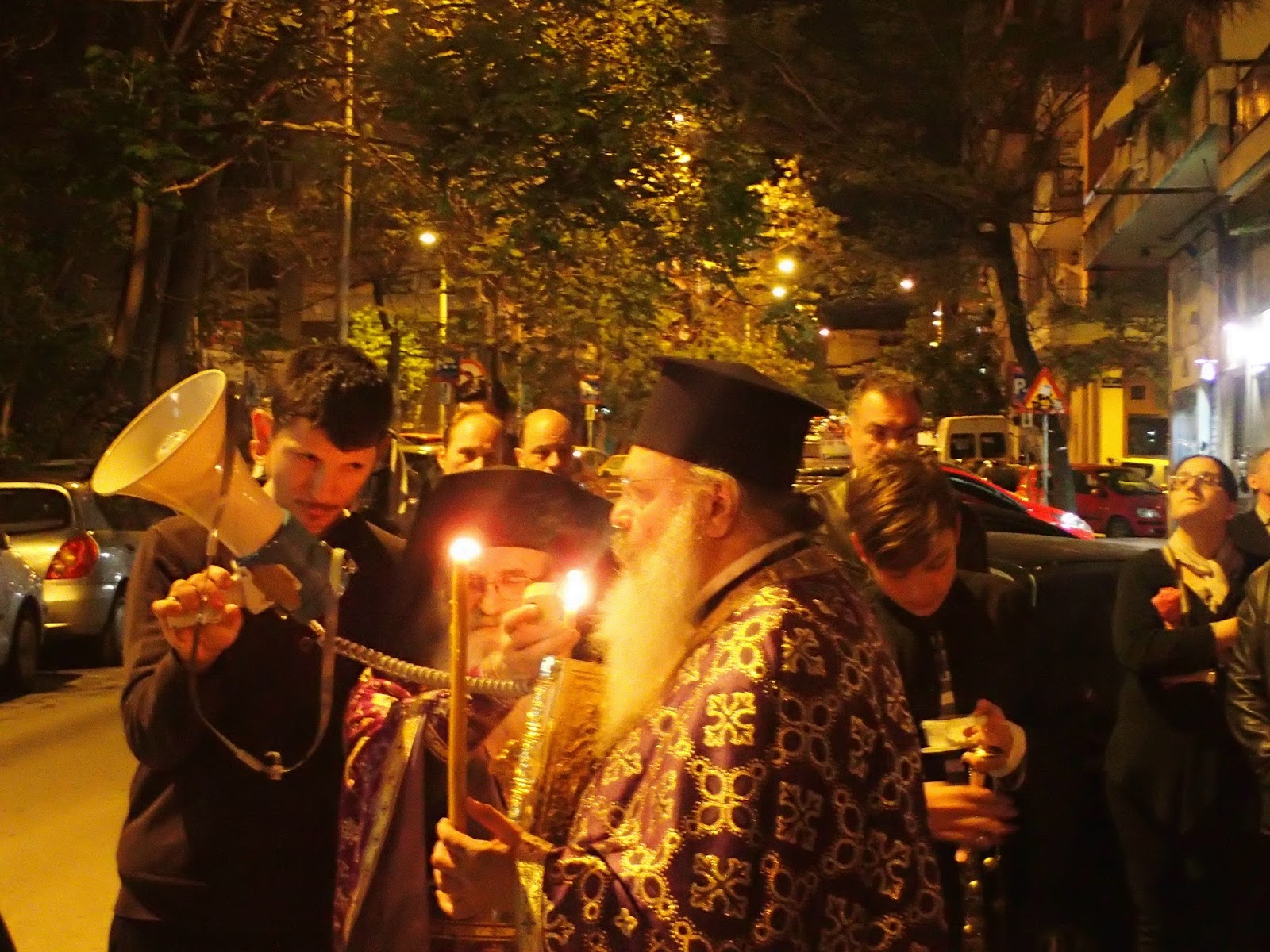
Good Friday is- technically- not joyous, and certainly not brief. Bells of mourning have been pealing at measured intervals all day. The stores open around noon so everyone has time to kiss the epitahio. After sundown, the church fills up again- to kiss the epitaphio if you haven't already- and then to file out of the church to join the procession around the neighborhood.

For a couple of hours, the city transforms. Decked out altar boys-


priests with megaphones under the golden streetlights-


and the blossom covered Epitaphio followed by the congregation make their way through the streets, 


navigating through the parked cars. 

At the lager churches, a military marching band joins the procession, and so do the scouts-


Everyone's holding candles, also form the balconies above, and as solemn an occasion as it is, there is joyous anticipation. The flags are at half mast now-


But we will all be back here tomorrow night for the church's most joyous, light-filled moment of the year


to say Χριστός ανέστη (Christ has risen), and Κάλο Πάσχα (Happy Easter), take the light back with us into our homes, and feast with joy.

Read More »

Wednesday, April 27, 2016

The Fragrance of Easter


Greek Easter is a season, not a day. Clean Monday- the beginning of Lent- starts the long build-up from the the season of naked branches to the season of leaves the size of children's hands. The last of the apples, a little withered, give way to the first strawberries, as nature illustrates the spiritual rebirth. The most solemn week of the Christian calendar is, in truth, brimming with joyous anticipation.


Palm Sunday brings the welcome taste of fish- those who have been observing the Orthodox fast have had nothing of creatures with blood- no meat, dairy, eggs, or fish, eating only seafoods, vegetables, olives, oil and bread.


Holy week, the fast resumes, with many from Wednesday on taking no oil, and some from Good Friday fasting altogether. Of course, alongside the fast, joyous preparations begin.

Tsoureki fresh this morning at our neighborhood bakery "Thoma"
The Easter treat is tsoureki- a sweet, eggy bread rich with butter- not unlike challah or babka or kulich.  Depending on the region and the household, it will be flavored various ways- mahlepi, the inner seed kenel of the pit of a certain cherry (like noix from the pits of apricots) is classic- it is said to taste like cherries and bitter almond, but to me it smells much more mysterious- and a little musty- like incense. Others use mastika, the dried resin of a wild pistachio tree that grows only on the island of Chios (the source of our verb masticate)- it looks like a crystal and tastes like a forest.

Clockwise from 7 o'clock- mahlepi, cardamon, and rocks of mastika.
You can buy great tsoureki, but then your house will not be filled with the scent of Easter. The dough is satisfying to knead and fun to braid and twist into shapes. A child, covered with flour and standing on a chair next to a patient grandmother, can usually be called on to help with this. Tsoureki bake astonishingly quickly- a moment too long and they are dry. Tsoureki should be moist and pull apart into long strands, the mark of thorough kneading. I would gladly share a recipe with you, but I am still searching for the right one.

Ingredients for tsoureki, including a special flour
The same day, commemorating the crucifixion, we dye eggs truly deep blood red- a color you can only buy in markets that sell things to Orthodox communities. No amount of food coloring will get the effect. The eggs will be polished lightly with oil, and whatever are not braided into the tsourekia will be displayed on the table, to be brought to Church for the resurrection on Saturday night. The dye needs lots of vinegar- simmering with the dye it fills the air. Like the smell of tsoureki baking, you can tell it's Easter with your eyes closed.

Good Friday on an island must be wonderful- friends tell me that when they were girls they would gather the day before to decorate the Epitaphio with flowers. I don't know who prepares the Epitaphio in the city but, they are covered too, flowers woven all over the frame and canopy. In the evening, people gather at every church to follow the epitaphio though the streets in a procession. All along the way people come out onto their balconies with candles. Sometimes two processions meet- In Thessaloniki, the Epitaphia of Grigoriou Palama and Agia Sophia meet at the intersection of Agias sophias and Tsimiski. The altar boys are little guys; they get bored waiting- once two of  them ended up on the ground, horsing around in their elaborate robes. The nun was cross.

The next day is madness- all last minute gift shopping and hair salons, mageiritsa cooking, and buying lambadas- candles to receive the light of the resurrection. What's mageiritsa? You'll probably know there is usually a whole lamb (or goat) roast on the spit for Easter Sunday. the organs are wrapped into tight bundles with the scrubbed-clean entrails to make this traditional Easter Soup- these bundles simmered in an egg-lemon broth green with fresh herbs. This is the soup to break the fast after the resurrection.

Sometime after 11, the churches and and grounds and streets around them fill. We're all dressed up, and some of us not necessarily modestly (after church is mageiritsa, and after mageiritsa- bouzoukia). Around midnight the bells toll and the light of the resurrection spreads from the church through the crowd, the scent of flames and melting beeswax fill the air as one candle lights another, a joyous moment.

Technically it's not the mageiritsa that breaks the fast- that is the first meal. But the first thing we eat? The eggs- we have all brought red eggs from our homes. and not just any red eggs- everyone has chosen their own egg, the one they think has the best chances against the other eggs- we crack them against one another, end to end, the aim that your egg stays intact. And now it's mageiritsa, the whole family around the table. No one will be in bed before 1:30 or 2 tonight, not even the children, and many of us will not go to bed before the sun rises on Easter morning.

More on Easter:

Imam Biyaldi- perfect for Holy Week


Marble Eggs from onion skins


Ricotta Pie Esperdy (for a taste of Easter in Manhattan)
Read More »

Tuesday, December 29, 2015

New Year's in Greece- More Family, More Feasting, More Everything.


Pressure to have a good time makes true enjoyment elusive. New Year's Eve as I knew it centers on a countdown, and don't even get started on who to kiss. Here in Greece, New Year's is a fat two day holiday (and you kiss everyone). Like many things on the charmingly relaxed Greek time table, the jovial Saint bearing gifts is later than everywhere else- it is St. Vassilis, not Claus or Nick, who slips down the chimneys of Greece, and he celebrates on January first (along with everyone named Vassilis or Vassiliki).

Like Christmas Eve Day, New Year's Eve day starts early- more little carolers, this time with a a different song. Same as before, save up your change. And if you had hoped to sleep in a little, set some earplugs out on your night table the evening before. But don't sleep too late- you'll miss them altogether. The door bell used to ring all day, not just a few groups in the morning.

When you go downtown to shop (and you should definitely go downtown- this holiday in particular, and Greece in general, is not about convenience), bring more change-carolers are everywhere- also very practiced students with instruments and varied repetoires. And like before, bring chocolates.

Go early so you can finish up in enough time to join your friends for an ouzo- everyone is out today and with even more "kefi" (Greece's boisterous, infectious joie de vivre). 


The best part of New Year's here is that there is a family dinner. There is all the glitter of soires as abroad, but they start after midnight. Before midnight, the streets are quiet and the bars and clubs are dark- everyone is home enjoying a large family dinner. Like elsewhere, someone turns on the tv a few minutes before midnight strikes to get an accurate time. The first person to step into the house after the New Year strikes who was not in the house when it did, is said to bring the luck of the year. For this reason, a few strokes before the hour, the halls of apartment buildings are filled with festively dressed children waiting to step in, right foot first, bringing with them good fortune. Everyone kisses everyone on both cheeks with good wishes for health and joy.


To ensure that good fortune may be as abundant as the garnet seeds of a pomegranate, a whole one is smashed against the wall to burst.  Like the glass at a Jewish wedding it is wrapped, although less festively in plastic. Still, the walls of our hallway are splattered deep purple towards the bottom- no plastic bag can contain the enthusiasm of children hurling good fortune- and it needs to split open for the luck to be released. This all happens quickly, because we then all spill out onto our balconies, to see the fireworks and greet our neighbors from across the streets and alleyways.

And the cold quickly chases us back in again, to cut the Vasilopita- the New Year's pie. 


The window of every neighborhood bakery-
this one in Ano Poli,
across from the church of Agiou Nikolaou Orphanou-
display the festive Vasilopita for 2016.
The pie is actually a cake, either a sweet yeast-risen butter-rich bread like a tsoureki (a challah or babka type of bread), or a simple orange and yogurt cake. A coin signifying luck has been baked into it. The cake is simply decorated with the New Year, often stencilled in powdered sugar. If this is the case, the pieces are identified by making in the sugar. Otherwise, we use a paper graph. The first piece is for the Savior, the second for the home, then there are pieces for each family member and guests, To even up the count, we often fill in with things that matter to us- our club, our pets (this is not strictly traditional- but surely there are many slices named for favorite teams....). This ritual is repeated throughout the month of January- in school classrooms, offices, and clubs of every kind.

You would think you would be tired by now. But after the children are tucked in, the streets jam with traffic. By one o'clock everyone is out in their way to celebrate. There are special holiday programs of live music, and celebrations of all the Vasillis and Vassilikis, private parties, and festivities at every bar and many restaurants. 

The morning of the New Year starts early if you have children- just like Christmas morning elsewhere, they want to see what is under the tree. We nibble on slices of vasilopita (and drink coffee), and relax with out families, If the sun is out, as it so often is on the first day of the year, we dress up and go for a walk- the promenade at the seafront is full of neighbors exchanging good wishes. We return home for another festive meal, grateful for the good fortune that brings us together.


And some us may take a swim.

Wishing you Health and Joy- καλη χρονια!


Read More »

Sunday, December 20, 2015

Celebrating Christmas in Greece.

Agia Sophia. Thessaloniki.
For the most part, we have to make do without a sugar-coating of snow (unless we drive up to the mountains- never far!). Apart from that, the Greek holiday season has everything going for it, classic, spontaneous, and above all, authentic. Festive, generous, and maybe not so commercial.

Christmas-

It is not St. Nick or Claus that the children await, but St. Vassilis, who is celebrated on January 1. Even if you are not religious (or Christian), it's refreshing to have this otherwise gargantuan holiday have less emphasis on shopping, more on generosity, friends, and gratitude. 

The week leading up to Christmas-

Make Kourabiedes and Melomakarona- they are in every house and every shop. Or buy them (but at least make the Kourabiedes- they are all about the butter and the store bought ones are with cheaper alternatives. Also they are very easy to make.) 


Buy mandarin oranges- they make the house smell fabulous! Everyone has them around for the holidays. Get a few kilos- forget pointsettas, you want mountains of these! Get them at the weekly "laiki" market- cheaper, fresher, more fun.


Christmas Eve day- 

This used to start early, really pre-dawn early. Why? The "Calanda." I would lose sleep for this custom any day. Kids go door to door singing one specific carol (they come back New Year's Eve day, with another specific carol). They say "Should we sing it?" and we answer "sing it!" and they do, as fast as possible, not always skilfully, and with triangles clanging hectically. Why so fast? We give them money. They make a shocking amount! In the past the bell would ring constantly. Now, we are lucky to have five or six groups a day.

Hope for the best and start saving up your change. We want to keep the custom alive so be generous- a euro each and five for a larger group is not too much. 


Christmas Eve Day-

Resist the practical urge to shop for your meal in advance at a well-stocked supermarket on the edge of town. Get whatever you can at your small local specialty shops (reserve your meats in advance)- each is decorated and full of cheer.

My favorite shop on Kalidromiou,
Exarchia, (Athens)
Leave a few of the lighter-weight purchases for town and brave your central market- three days a year seized with madness- today, the 31st, and "Tsiknopempti." Buy your cheeses and meet up with friends at the impromptu street parties at every cafe and shop. Smoke from grilling souvlakia fills the air. Gypsies are out with drums and clarinets (better from a distance). Gypsy kids are out too. I'm pretty sure they don't get to keep the money they gather, but they will definitely eat the chocolates that buy specially in order to stuff into your jacket pockets or bag to share with them. And get some roasted chestnuts!- Thessaloniki, Athens, Rockefeller Center- smells like holidays. And a cup of Salepi- a thick hot drink from the pounded root of a wild orchid-


Too loud and crazy? Stop into a church, light a candle, and think about things to be grateful for-

Agios Dimitrios, Thessaloniki. 
Try to get home in enough time for a nap, because Christmas Eve is family first, and "Reveillon" later- after a family dinner, many go out for Reveillon at bouzoukia and bars, returning in they soft gray light of dawn. In addition to the holiday, all the Christos and Christinas have their name day tomorrow, and many are out celebrating tonight.

Christmas Day-

A big family dinner- lamb or goat, or often the only time a year a Greek family buys a turkey. The typical stuffing? Rice, with chestnuts and pine nuts. No cranberry sauce (they totally do not get it. "Jam? Jam with the meat?"). It's delicious anyway. More Korabiedes and Melomakarona, and usually some Champagne!

The 26th-

Businesses and shops are closed for the second day of Christmas- a relaxing day for seeing family and friends. But cafes and bars are open (Clubs too- we are having our Christmas party with the Speakeasies, Thessaloniki's fabulous Swing band, and special cocktails by Charlene- if you are in Thessaloniki, come by!)

Now we have the rest of the week to prepare for the New Year's celebrations- a holiday Greece does superbly.

Kala Christouyenna.


Read More »