Showing posts with label Lifestyle. Show all posts

Thursday, May 4, 2017

Carpe Diem, Greek Style

Dawn at Eumelia- a Laconian Ideal.
One of the best things about living in Greece full time is the relative tranquility of the spring and fall, the experiences this makes possible, the connections to the rhythms of the existing culture which get covered over in summer by millions of people- often seeking, ironically, just those rhythms. The off-season experience of Greece is often more authentic, more intimate, and that is why it is one of the things I write about, here, and elsewhere. The tourist may seek sun and, often, excitement- nothing wrong with either and in summer there's plenty of both. The traveller, on the other hand, seeks authenticity. But these travellers are sometimes academics, or sometimes parents, or both- people whose holidays, though not short, coincide with the peak season.

The yard outside Dionysus Aeropagitou in Kolonaki
Finding your own private Greece in the high season:

If you find yourself visiting during the high season, you will still find intimacy and stillness in the off peak hours- some of the best in the Greek summer day. Eos- the Goddess who brings the dawn, is famously- and here in Greece, still- described as rosy-fingered. More recently, Lawrence Durrell goes on and on about it:

"The days dawn fine and cool this time of year... their crisp, dry felicity is almost shameful. Wilde would have said something nasty about nature imitating art, but in truth the Greek dawn puts words to flight, and painters out of business."

It's dawn on the Ioanian islands he describes, but it could just as reasonably even be Athens- although hardly cool in July, it is never cooler than it is at 6 am. The birds will wake you- the cicadas are still sleeping at this hour. The old men- skilled in art of carpe diem- are up before daybreak and their cafes are already open. Have a Greek coffee with a thick head of foam on it, "sketo" (no sugar), listen to the rustle of newspapers and the gossip of the morning while the shadows are still long. Or take a daybreak swim- although no matter how early you go, the old men will have beat you to it there as well.

If you have an agenda- and you surely do- greet it at once. Be the first at the Parthenon, before the stones have heated up from the sun. The longer shadows will make for more striking viewing, and there won't be a third as many people as there will be an hour later. If there's any hour suited to contemplation at the Parthenon in summer, this is the only one. (I fell asleep here when I was 14- having not been in Europe but 10 hours, I was still jet-lagged). This surely holds just as true for Knossos. 

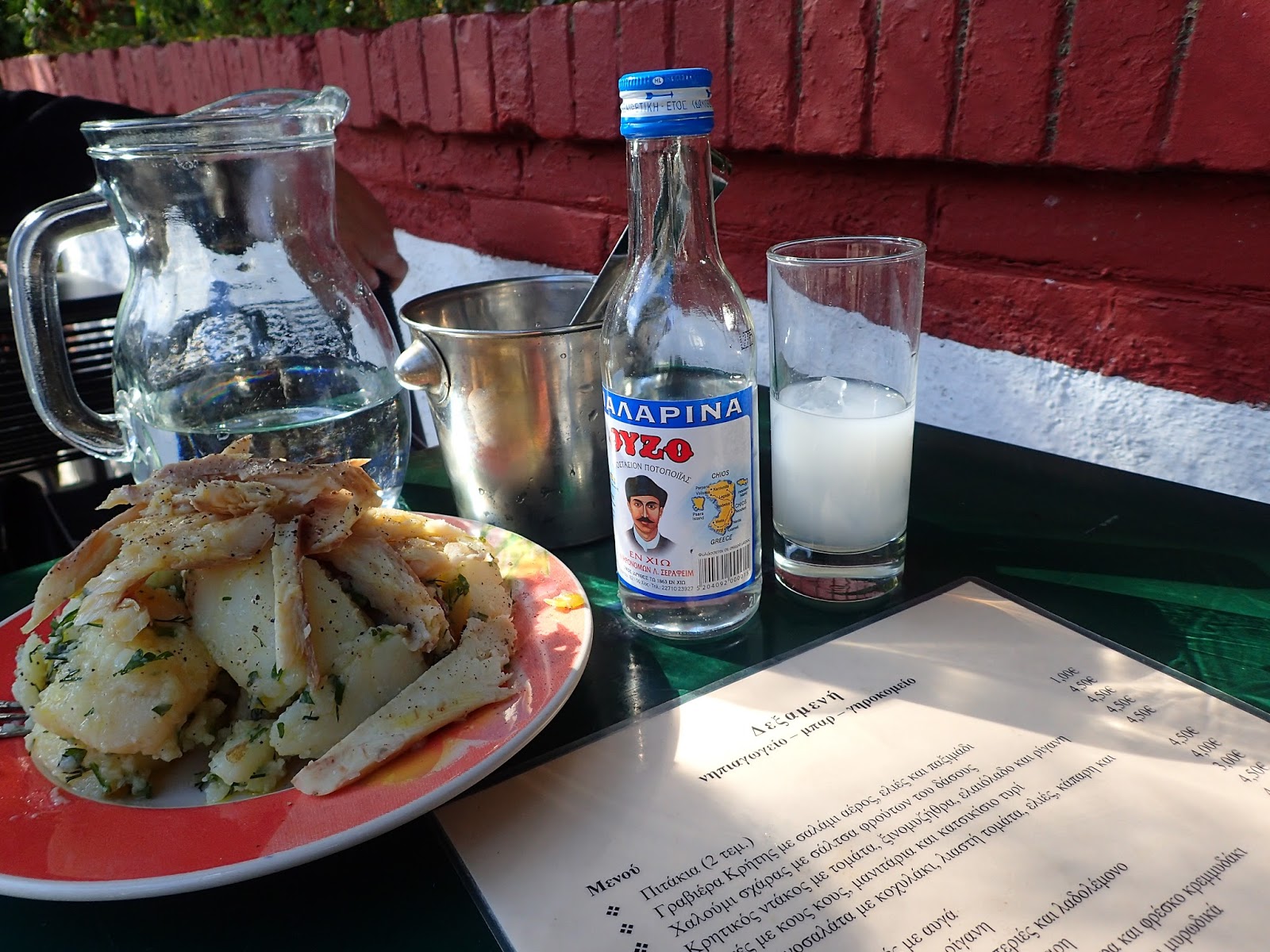
Move on to another activity before the great heat sets in. By noon, you could be starting a long lazy lunch, and there is no shame in wine or ouzo at this hour, especially if you were up with the birds.


Mid-day ouzo meze at Dexameni
A rest at Eumelia before the most delightful wine tasting, ever.
Siesta

You'd think it's the heat that makes the siesta so attractive, but really it's two other hallmarks of the mediterranean mid-summer. "The light of Greece opened my eyes, penetrated my pores, expanded my whole being." Henry Miller exaggerates not one bit- and, though glorious, it is not easy to hold up to illumination of such intensity. No Greek house is without shutters to create a refuge from the light of midday, and the quality of the darkness cut through with little knife blades of blinding white on a parquet floor is palpably quenching.

The other thing that will put you to sleep is the cicadas. They are as loud as the light is bright, but their song is so hypnotic that if they stop all of a sudden, which sometimes they do, the silence wakes you like a slap ringing in the air.

Siesta, ideally, is more than a nap. Wash your face, undress, lie between white cotton sheets. Even without wine at lunch, those cicadas will knock you out cold for the most intense sleep you will experience all year- nothing to do with the unconscious hibernation of winter. After vivid dreams, most of which you will remember, you'll awake well before sunset, pleasantly disoriented, and with enough time for an evening swim or dressing for "volta."

Fresh from a deep sleep, enjoy the second morning of the day- a coffee is not out of place. There will be plenty of time for it to wear off.

Dexameni, again- ideal any time of day.

Most romantic restaurant in Athens- Point α- with Travel Bloggers Greece
"Volta"

Promenade- "volta"- is still very much the thing. No one really schlumps around much after 6 pm. Although there are no set rules (heels, a tie), dress as though you will be constantly running into people you like and that they will be asking you to join them for an ouzo, because that is what pretty much always happens. You might want to go to a performance in an ancient theatre, or an outdoor concert, or maybe just a film, seated in deck chairs nestled in white gravel among climbing jasmine, under the stars.  Or there's dinner- late, light, and long- mainly an excuse for conversation and ouzo. Not surprisingly, Lawrence Durrell also weighs in on the pleasures of the Greek night: "It seems a crime to go to bed early in Greece, and even the little children are allowed up very late, so that when they turn in they sleep a really dead-beat sleep, instead of spending the night whining and sucking their thumbs, as so many northern children do." You'll sleep this same dead-beat sleep too, for a few short hours until you wake, refreshed, to another rosy-fingered dawn


Intermission of Carmen, at the Herodotus Theatre

Read More »

Friday, September 2, 2016

Style and Substance- Vintage Fashion at Yesterday's Bread, Exarchia (Athens)


Exarchia- haven of ruthlessly independent creative activity- makes me homesick, for a time as much as a place. There is no Starbucks, no Accessorize, no multi-national faux culture or ersatz style. In short, welcome to 1980's Manhattan.

Although I adore watching Sex and the City, it has ruined my beloved city's reputation. I love the fun and the fantasy and Patricia Field's marvelous vision, but there's a vibe of trying way too hard that is very not Manhattan, and particularly not downtown (the word "downtown" automatically embodying the ethos from Taxi Driver to Paul's Boutique). Of course we put in effort, but it was organic, indigenous, creative, and above all, pretty cheap. The very few new things in our wardrobes came from the designers themselves (Betsey Johnson still had stalls at street fairs, and I could afford to shop there with money I earned babysitting), or from Capezio (leotards and butter soft ballet slippers- meant for hardwood. After a week on grimy sidewalks we were essentially barefoot), but most of our clothes were from flea markets and vintage shops- bed jackets (worn over a leotard, with old jeans and ballet slippers), fedoras, ball gowns (also to school), pegged black jeans from Trash and Vaudville and t-shirts we cut the necks out of (my favorite was from The Specials)- these were our school clothes. From Patricia Field's shop on 8th street, we bought boxes of face powder from Japan. It smelled like cherry blossoms.

So, back to Exarchia-

Charlene my older girl and I were on a trip to Athens a few years ago, and she was at this perfect age where she was starting to understand what she wanted to project, but she had trouble finding the raw materials. She got a Hell Bunny dress covered in playing cards in London on the way to San Francisco, some frilly knickers thing at Dark Garden (custom corset shop) in Hayes Valley (SF), and a Series of Unfortunate Events - mood dress in Edinburgh when she went for the Fringe with her dad, but the rest was pretty much McBershka. You don't really want to find a piece of yourself in a multi-national mega shop.

So anyway there we are on Benaki- in this sweet neighborhood that, like '80's Manhattan, doesn't need to try too hard- and she sees this poster in the window of the furniture repair shop- a Betty-Pagesque girl with a '50's dress and '40's shoes was standing in a distinctly Exarchia doorway. She does a little squeal- real girl, real clothes, real style. There was a name- Yesterday's Bread- and an address- Kalidromiou, close to where we were staying, a block or two from the square. 

That's where we met Strato and Daphne, who, although we have seen them less than a dozen times, are very much a part of our world. Each of my girls found a piece of themselves in this shop, like they could finally realize a vision that had only been abstract up to then. The store is made for this- just enough organization to find what you need- rows of men's jackets, rows of dresses, etc., and just enough chaos to make it feel like a you broke into the wardrobe room of a theater- steamer trunks of scarves, of corsets.   We stayed a couple of hours our first visit- she tried on lots of things, refining and self - defining as she did. After a while, Daphne could see where she was going and helped her get there. Charlene got lots of stuff, a vintage one-piece, shirts, dresses. 


I got a dress too- full skirted, shawl collared, self-belt, that I wear all summer, and a leopard cape I wear all winter.


Another time Charlene came back with a burlesque/circus dress, ruffles, trailing at the back, short in the front, very Panic at the Disco. It's not conventionally practical, but on the other hand, when you need it, you really need it- nothing else is going to satisfy that mood. We like a sense of occasion in our household.

Mei Mei went a few years later, at that exact same time in her life when she was deciding how she wants to look. She got a kelly green polka-dot skirt, some vintage pin-stripe converses, and a beaded satin evening bag, shaped like an owl. She wore them all to tea at the Grande Bretagne:

Mei Mei in Exarchia on her way to tea
Getting ready for school
On our next trip, my mother bought her a floor length strapless black lace ballgown, and a mauve velvet hat. She wore the dress to her beach party for her 18th birthday, and many times before and since. My mother also bought a bold babushka scarf for herself, like the kind from the Ukranian stores on the Lower East Side.

So why all the stories? Because clothes matter. You can have an all night beach party for your 18th birthday in a dress from the H & M, but something will be missing- clothes are a part of your history, as essential for defining who you really are as a costume is for a character on stage. How does vintage help in the the quest for figuring out who you are? For one thing, wearing clothes that already have a history of their own can give you a head start. Fashions recall eras, and all the things that belong to them- philosophy, design, politics, and, not least, music. Also, things are a lot more special when there is just the one, not hundreds, in the city.

Check Yesterday's Bread's facebook for their store hours. From the square of Exarchia, go on the mostly pedestrian street Tsamadou until you get to Kalidromiou (3-5 minutes)- make a sharp right and it's just a few steps up. (If you're visiting the Archaeological museum, it's right near by).

I didn't mention the prices-  they are very, very good, but that's not why you would come.

You could think of them as rescuers of fashion. They're also rescuers of dogs- met Beer, the wobbly legged baby pointer Daphne found:


Beer sent Fiona a bandanna:


Yesterday's Bread
Kalidromiou 87-89
210 881 1233

More pleasures of an authentic life in Athens-


Not so Ancient Athens- a mysterious antiques bazaar near the fish market


Community and Culinary tradition (Food, and a little Love- at Mana's Kouzina Kouzina)
Read More »

Friday, August 5, 2016

The Queen of Koym Kapi


How often does anyone say "It's the end of an era." when someone leaves the world? They have to be someone extraordinary. I have been lucky and have known three, women all- my grandmother, who died in 1991, her best friend who died just last year, lingering to hold a three day long cocktail party in her home for people to give their respects (it was packed. She wore lipstick, and held the lightest of drinks on her delicate, manicured hand. She was our last link to our favorite generation), and now a lady who left us just last night.

Eirini was the mother of my dearest friend, grandmother of my daughter's dearest friend. Loving and affectionate as she was in those roles, you somehow never thought of her in relation to anyone or anything else. Her existence was so grand, large, it could be contingent on nothing but her vibrance and verve. She had enough personality to be completely New York and completely Cretan at the same time- not expat, not immigrant, just utterly cosmopolitan. 

For those of you who haven't been, I'll introduce Koum Kapi, the easternmost of the three bays of Chania. It's a working class neighborhood, simple houses and shacks, narrow streets, a couple of 1970's apartment buildings, all around a fabulous beach- a ring of rocks we swim out to and kids dive from on the right, and the golden stones of the Venetian fortress on the left. The sun sets in between, a little more toward the fortress than the rocks. It is, like this lady, effortlessly beautiful, with integrity and innate, authentic style.

Every summer, a ritual drink on her balcony (so close to the sea it feels like you are on a boat, and nearly next door to our own apartment) marked the beginning of summer for me. Her living room, enormous and spare, had two day beds for lounging, some over-the-top mirrors, and an enormous chair she would have recovered from time to time to suit the mood. This was always changing - a different color of drape, an object or two, and she would effortlessly create a completely different environment; it was curated, there was an element of fantasy, more like a set for living. She had been a fashion illustrator in New York, making dreamy, evocative sketches we loved to look at. Copies of Vogue were stacked high in one corner- we would leaf through them while drinking Cretan wine poured from a plastic water bottle into short French tumblers- she knew quality, not pretension, and once you have tried the tawny rich wine of Crete that smells like an amontillado and is so strong you need an ice cube to dilute it, well, there is nothing like it. That living room functioned as a modern day salon- family and friends converging at their dynamic center, the heart of their world. It was also a haven, a place I was grateful to always find welcome. Style's not much without grace- she had lots and lots of both.

Her sense of high style was so timeless that it rendered her vaguely immortal, or, at the very least, ageless. We were out late one night and ran into her having drinks with some friends. We joined them. Pavlos later remarked "when you're out with her, you're just out with a woman." She was a year or two before 80 then, smoking, having a glass of wine, and talking with joy about culture, design. She was wearing one of her flowing caftans in a solid color- this one in vivid lilac, with excellent shoes and an even more excellent bag- bold and large. She had a collection of them. Of caftans too- the best was the chartreuse, not so much because of the color itself but because of the chutzpah of the color- you really have to be somebody to wear chartreuse, and she was somebody. She wore it like other women wear navy, or gray. I saw her one morning waiting to cross Venizelou, a sack of oranges her net shopping bag, in that chartreuse caftan and large sunglasses, all poise in the sunlight. She smiled and waved. She made the whole neighborhood feel more glamorous. 

Is being beautiful a pre-requisite for living a grand life? Well, it can't hurt. Just last night I was at the cinema and Claudia Cardinale was playing. She must be close to 80, and I thought how beautiful women stay beautiful forever. That was just as my friend was leaving the world, her magnificent features only amplified in age by her animation and the very richness of life well-lived. As to beauty, maybe it does lend a quality of the epic to a life story. Certainly it did to hers, and we loved hearing about it.

Why all this talk of fashion, of elegance? It's hardly considered a virtue. But that's a mistake. When it's coming from someplace real, elegance expresses the highest virtue- making an occasion of life- an expression of reverence, and joy. 

She did, and will always, embody for me a particular excellence, the virtue of a life so well and gracefully and boldly lived. Eirini was someone who inspires you to make an era of your own.
Read More »

Saturday, May 14, 2016

Mastering the Art of Greek Drinking


Our happy corner of the Mediterranean has a reputation for Dionysian chaos. This is just a half-truth. A Dionysian joie de vivre does set the tone of everyday life- with that, there is plenty of drinking. But none of that drinking is chaotic. Drinking, in fact, is probably one of the least chaotic things about Greece. The relationship to alcohol here is refined, elegant- a defining aspect of culture. What makes it special? 

In Asmomatos, Lesvos, with friends.
First, this is a sociable culture, and drinking is a sociable activity. Drink is parallel to conversation, not an end in itself. As this is Greece, there will probably also be something to eat- our next point:


- Traditional Greek drinks- raki, tsipouro, tsicoudia, wine, retsina, and- perhaps especially- ouzo- are classically enjoyed with food. Why do I say especially ouzo? It's very name is linked with food- an Ouzerie is a type of restaurant where you have a variety of small plates with ouzo; ouzo mezedes are the meze (small plates) that are made to enjoy with ouzo. Ouzomeze (spoken as one word) is your order in a classic Kafeneio- where a glass of ouzo automatically comes with a small plate of bites (an olive, a smear of tarama, an anchovy... ). This also applies to international drinks- cocktails. Cocktail bars generally have no kitchens, but the snacks they bring- even if just mixed nuts and potato chips although very often there are cucumbers, carrots, olives, cubes of cheeses, breadsticks- are better and more plentiful than you may be served in other countries. 

- Alcohol is not stigmatized and marginalized in Greece. Children can be sent to the kiosk for cold beers if we run out during a barbecue. My daughters had wine on a field trip to a vineyard in grade school ("Oh, not much mama- just a sip."), and they have beers with their teachers on the weekend trips they take in High School. The happy result? - a slow introduction to drinking, in a social context. You may see a drunken teenager in Greece, but not often, and rarely are they dangerously drunk. It just doesn't have that juvenile thrill of the forbidden.


-There is no "open container" law- you can get a whiskey at the outdoor cinema, and you can get a cold bottle of retsina and some plastic cups at the kiosk, and sit on the ground at the waterfront. A group of university students enjoying the sunset together this way is a happy sight.

-Lastly, and most importantly, it never seems to bring out the worst in people. Convivial, jovial groups get a little bit loud, and there is more laughter. As to fighting and public vulgarity? - very, very rare. 

(Amid so much to admire, one improvement is vital- both education about drunk driving and enforcement are deeply wanting.)

The nicest part about drinking in Greece is that the easy flow of alcohol, the nearly constant raising of glasses, is anything but chaotic. There is order, and grace- custom continually reinforces drinks' place of bringing the group together, of commemorating the moment, and celebrating life.

Mastering the Art of Greek Drinking:

- Whatever the drink (wine, tsicoudia, beers, ouzo), you don't just start drinking. 

- Don't worry, you will not go thirsty. After everyone's glass has been filled, there will be a general "γιάμας!" ("our health!") to start things off. Thereafter, sip from you glass as you like.

- Well, not exactly as you like- there will be some mandatory drinking when a new round of toasting is occasioned, such as:

  • If anyone new joins the party, we will all toast afresh when their glass is filled for the first time.
  • Whenever anyone's glass is refilled, it is not uncommon for them to toast with the fresh portion. This happens a lot- glasses are generally small, and so refilled often, perhaps to this very purpose. You can fill your own glass, but fill the empty glasses of your neighbors first. Who fills whose glass? Just as you wish, but it much follows the pattern of society in general- gentleman often fill ladies' glasses, and you fill the glass of your great aunt.
  • From time to time, someone will simply be seized with the impulse to toast. This is particularly the case at a large table- a party of six are often engaged in the same conversation; a party of seven or more, you will likely be engaging with your closest neighbors. A toast reunites the group.
  • Is there a happy event coming up? There will be more toasting still.
  • Is this all sounding like too much? By all means, do join in every toast. Just don't take a mouthful- wet your lips with the glass.

(As glasses are raised in one of these impromptu toasts, there is a quick scan- any glasses needing a refill get one now.) These occasional toasts bring a large group back together. Although rising from your chair to chime glasses with someone otherwise out of reach is not mandatory, it's very much in the spirit of things to do so, at least some of the time. At other times you meet the eyes of those seated far away and raise your glass to them. 

Sound complicated? It quickly becomes natural- in fact, it is difficult to unlearn. Visiting San Francisco, I was half through a festive meal and parched for my first cool sip of white wine. But what was I to do? No one had toasted yet, and I was not the host and also the youngest by a generation. I looked around and saw everyone drinking at their own pace. Much as I wanted a sip myself, taking it without ceremony did seem unhappily occasionless.


That is perhaps the the key to letting just the right amount of Dionysus into our lives- making an occasion out of every day.

For more on Greece's iconic national drink, read about:


The Essentials of Ouzo


The Culture of Ouzo, Lesvos Style
Read More »

Wednesday, March 9, 2016

Sanguini (Blood Orange) Marmalade with Orange Blossom Water.


It's easy to get used to nice things, and so hard to do without them once you have. Homemade jam is such a thing. I remember I used to buy jam in the store, and I even remember it being pretty good. But when you start having your own, there's no going back. It's not as great of a commitment as it sounds. Small batch urban canning is spontaneous, fun, simple, and gives out a huge payoff of seeming virtuous- that's the sanguine part. Actually, it's just cooking up some fruit and some sugar, one of the simpler lifestyle upgrades. The scent fills your home.

Stone fruits and berries follow one simple ratio that works for them all. Oranges, on the other hand, need a lot of water and a little finesse. This is only logical- they are complicated fruits with zest, pith, membrane, flesh, pits. They also have a complicated personality- sweet, tangy, and- what makes them so special for jam- bitter.

Blood oranges- sanguini in many languages- have plenty of zing and make for very beautiful rosy marmalade. To round out the bitter-tangy-sweet, we added some floral- a spoonful of orange blossom water at the end. Ethereal, with some depth.

We will need:

500 g / 1 lb small blood oranges (4 or 5 )
800 ml/ 3 generous C water
600 g/3 C sugar
a little lemon juice
1 spoonful of orange blossom water

Scrub the oranges well. Cut them in half, place the cut side down on a board, cut lengthwise in half again, then, holding the two halves together, slice crosswise into thin, quarter-round slices. A serrated bread knife works well for this. 


Your cutting board will get a pinkish stain by the time you are done.

Cover the slices with water, put a plate on the bowl, and keep overnight. This will let the peel soften. Put three small white plates in the freezer so you don;t forget the next day- these are for testing to see when the jam is done.


The next day, pour the orange slices with their now very flavorful water into a large tall pot, bring to a boil, and add the sugar.In the meantime, have ready a couple of sterilized jars and lids ready. this will make enough for 2 or 3 300 - 400 g jars.  Keep boiling the fruit, stirring most of the time. after abut 15 minutes, there will be less froth, the bubbles will be larger, and you will hear the jam stickingtothe bottom of the pan. Turn it down if you are worried, and stir constantly. It seems to take forever, but once is starts to thicken, it thickens very quickly. as soon as it looks syrupy, put a small amount on one o the frozen plates. Let it cool a moment, and run your finger through it. If the trail of your finger remains for the mos part. it is done. We are not looking for a clean trail that does not close at all- that will be too dense once it sets. 

The splotch in the middle is perfect.
By the time I added the lemon juice and stirred to taste,
I had the splotch on the left- too clean.
It is delicious none the less, but try not to over do it.
When it is nearly done, add a squeeze of lemon juice if it seems too sweet. Then add as much orange blossom water as you like- I used a full teaspoon, and might have used more. 

Ladle it carefully into the jars. It is a lot less stressful to just let it cool and keep it refrigerated, but if you would like to keep it longer, or if  you have doubled the recipe and have simply too much, follow the simple instructions for canning included here.


Greece's Sparkling Gems of Winter.

Urban Canning, Chet Baker, and Nectarine Jam.


Read More »

Sunday, January 10, 2016

Prunes with Walnuts for Tea Time


An upcoming trip to Istanbul (tomorrow!) has put us in a more exotic frame of mind. Also, we are busy packing. But nothing keeps us from a pretty tea-time. These are simple and beautiful and made really with just two things- the prunes and the walnuts, plus tea and sugar which you already have for tea anyway.

We will need:
As many pitted prunes as you like
As many walnut halves as prunes
Brewed tea to cover the prunes- we used Earl Grey
A little sugar

First, a really good trick:
Check the walnuts- are they sweet and fresh, or a little stale? If they could use refreshing, boil some water, put the walnuts in, remove them immediately with a fine-mesh strainer, give them a shake, and dry them in the oven- ten minutes with a fan should do it, and crisp them a little. The water will have turned reddish-brown with tannins, now leached from the nuts, which will be sweet and fresh tasting (though not have the strong rich flavor of a perfect fresh nut). 

All we do now is cover the prunes with tea and simmer until they swell. The tea will become dark and thick with the juice of the prunes. Remove the prunes with a slotted spoon to a platter. Stuff each one with a walnut half, pretty side out.

To the dark prune-infused tea, add a spoonful or two of sugar. It doesn't need any sweetness, but the sugar will add body and gloss as we cook it down. Boil rapidly until it becomes a thin syrup. This should  only take a moment or two.

Pour the syrup over the prunes for serving. If you have it and want a little more exotic fragrance, spritz them with some orange flower water:


And to keep the motif, and also because the colors go so nicely, slice a peeled orange and dust it with cinnamon. Some strained yogurt, clotted cream, or labneh are just the thing if you want something more filling for tea-time.


When we are having these, we usually use our Turkish tea glasses rather than cups and saucers. 


Read More »

Thursday, January 7, 2016

Slightly Less Ancient Athens


"It tilts. Look."

"No no no- it's the shop that tilts. See how the old the wooden floor is? This is straight. It's the only straight thing in the shop."  We are looking at a majestic four-tired hotel tray of tarnished zinc- listing like a ship- and discussing its price. It's just a ritual; I don't care what I pay for it. The tray is the thing I have been waiting for my whole life to bring me closer to fulfillment and just never knew it- like a very, very minor version of falling in love. Considering the cut glass ice bucket, tongs, and a small silver cup that I bought that day, the tray itself was probably around 55? I could probably have got it down to 40, I think, but then it was July and it was so hot, and also I would have paid a hundred and not minded a bit- love's like that. Three-tiered trays are common enough; a four-tiered tray though, that sets a tone. We like our everyday life to have a tone. The tray is as tall as a toddler; if we lived in New York, it would barely be affordable to keep it filled with pomegranates, lemons, persimmons, and pears. 

After browsing the crustaceans at the Varvakios fish market, I passed a stall on the other side of the street with a charming mid-century amateur oil painting of more crustaceans- a lobster and two crabs. Dishes and tea pots spilled out into the street. The wooden spiral staircase at the back, nearly obscured by platters, chandeliers, accordions, phonograph records, candelabras, and clocks hanging from the banisters and walls, could only just be made out. It makes a full two revolutions before it reaches the main floor. And that main floor was shocking- a corridor and five or six rooms- some of these large galleries- are each filled with heaps of every imaginable thing, with as much order as the sacks of loot of pirates. It is tantalizing, dazzling. Dazzling and dangerous. The walk spaces are narrow, and the goods are piled so high and so deep it seems that not a tenth of them could ever be reached. The ceilings are high too, and tall windows let in some light in the distance. Were it not for this, it would feel like the vault of Bellatrix in Harry Potter, where when you touch anything it multiplies, and soon you are adrift on a swelling wave of candlesticks and water pitchers.


You expect a shop like this to be tended by an old man. Actually, it is a bunch of young guys from Egypt. I don't know how they came to have the shop. They're very genial, and seem to make a good price on the whole, throwing in presents you have at the edge of your pile (little marble dachsunds, for instance). Here are some of the things we have come home with. They make our life more sumptuous every day-

Souvenir spoons from a long-ago trip to Hungary.
Chinoiserie assembled over the course of three visits- they have a lot of it.
We have these tissue-thin etched glasses in two sizes, for water and for wine.
This cream pitcher has a matching sugar bowl. They have a satisfying weight.
No one ever cradles a tea cup and says "Do you remember when that thunderstorm came out of nowhere, and we rushed into Ikea, drenched and laughing, and you found these in plain sight with thousands of others exactly alike?" When you are in a city that has such a story as Athens, it inspires you to have one too, one for everything- to seek things that have stories of their own. 

The Bazaar is directly across from the Varvakios market, on your left as you cross Athinas St. They keep the hours of the market, and then some. After you shop, go for a chai. A sweet slice of Lahore is just a street or two away.


Read More »

Wednesday, December 9, 2015

Athens in Winter is all Charm and Grace, and Surprises.


Summer is the sun around which the rest of the year revolves, and fall- otherwise the season of newness and anticipation (shopping for notebooks, the smell of pencil shavings), is here in Greece simply the thing that comes after the "good weather;" The Greek word for "summer" is "καλο(good)καιρι(weather)" ("Kalokairy- accent on the third syllable); winter holds no good in its definition. But it is good- very, very good, filled with moody, subtle pleasures. Athens gets all plush muted gray like Paris does in the winter. It's a respite- none of that trying "penetrating" and "expanding" that so beguiled Henry Miller. You can take in every dreamy detail at your leisure; Miller's light of Greece hides as much as it reveals. Winter in Athens is very three dimensional, rich with detail, and all the time in the world to enjoy it.

Here is an Athens winter day, unplanned, unfolding by chance. They're all like this- perfect in their own way:

True, the Acropolis museum is spectacular- content, location, structure- all spectacular. But the Archaeological Museum smells better, has a great classic layout of endless grand rooms, and is jammed with riches- jammed. You cannot make a wrong turn with each thing more breathtaking than the last.

Double fun!
 This 2nd C AD Aphroditi was partially
 restored by Canova.

Or, more entertaining than the last:

Aphroditi again- her left foot is bare-
that's her slipper in her hand that she's about to smack Pan with.
the museum is at the edge of Exarchia, the neighborhood of riots, teargas, musical instrument sellers and restorers, publishing houses, and book binders- not always in that order. Also the neighborhood of grafiti art and incredible murals:
Scale-  One story tall-
the ants are about the size of a three year old.
Some things worth looking at are quite small, and you'd miss them in the blinding sun. Like the window of this book restorer:


"Artistic bookbinders- I. N. Mantzakos"
A magnificent little slice of a much earlier century, not much wider than one's outstretched arms. Blink and you would have missed it, as they say, and blink you would in the summer sun. Winter is full of these surprises.

The main shopping street, Ermou, is just that- wide and long and lined with international chain shops and full of shoppers. Every city has one. But right at a main intersection there is this guy:


selling salepi from his magnificent samovar, which is how you know you are not in Arizona. Salepi is a warm, slightly viscous drink, made from the powdered root of a wild orchid. I would not buy a warm viscous drink from a street vendor in a million years so I cannot tell you how it tastes, but I hear it is delicious. The salepi vendor is just a short distance from the Metropolitan Cathedral- itself under renovation. Next to it is an older Church- a more intimate choice for lighting a candle:


And next to this is Philothei street- which I discovered by accident in the heat of August 2 years ago and now visit regularly. This street is where the church shops- not household religious articles like icons and home altars, but serious stuff- Sceptres, Crowns (!), pigments for icon painters, bishops hats wrapped in white paper and lined up on glass shelves like panettone, and unbelievable textile shops. There is a hushed atmosphere that makes you feel like you are probably not supposed to be here, which makes it more interesting than it already would be.


These are not for the layperson- 
they are about the size of a hand.
Between this street of eerie calm and the serene grand promenade Aeropagitou is Plaka. It's not so big, and you can get a couple of postcards. Before you know it you are in front of the Acropolis museum, between going in or wandering aimlessly, and decide to wander aimlessly. Athens looks a little like Vienna from some angles in the soft wintery light:

Right behind Aeropagitou is the quiet street Kalisperi, with a perfect cafe. We stopped for an ouzo- the color of the sky:


And this was the view:


Through the bare branches can you just make out the Irodeio?  

More casual Athens pleasures-


Mysterious, enchanting Agiou Philothei street


Drinking Chai on Evripidou


A weekend of Picasso and Pastis
Read More »