Showing posts with label museums. Show all posts

Saturday, August 13, 2016

The Beautiful World of Wine at Ktima Gerovassiliou

We're gazing out over part of the sixty-three hectares of vineyard at Ktima Gerovassiliou. The sea lies beyond them, just out of sight. 


But it plays its role, in the mildness of the winters and in the temperate summers cooled by its breezes. The soil is sandy, rich in sea fossils. The vineyards teem with life- 28 species of birds thrive among the vines. Come mid-August, these vines will all be harvested by hand. Good wine needs good grapes, and harvesters with a careful hand and skilled eye. 


Suggestion of a vine by Kostas Tsoklis
Moon by Kostas Varotsos
We, too, are in good hands- with our guide Dimitra Bazaka, whose degree in fine arts enriches the narrative. Wine and Art are both creative expressions of truth, and Art is integral to the experience of Ktima Gerovassiliou- throughout the vineyard and grounds are contemporary sculptures from Greek artists of note, commissioned for the site by Mr. Gerovassiliou. This beautiful expanse stared out as a family vineyard of 2.5 hectares. Vangelis Gerovassiliou, after working as an oenologist at Domaine Porto Carras, returned to the family vineyard with his wife Sonia Tziola Gerovassiliou and in 1981, started to renovate, his first production of a grape close to his heart.

Of the varieties in Greece, Malagousia- making a white wine full of ripe fruits and fragrance and flowers- is special. Well, this delicious grape was nearly lost to time(!). A professor at the Aristotle University rescued it, and Vangelis Gerouvasileiou was the first to vinify it- an important contribution to the world of wine. The vineyard's first production, in 1986, was a blend of Malagousia and the Greek varietal Asyrtiko.


More grapes were added over time- both Greek and international- to the whites Malagousia and Asyrtiko (a varietal of Santorni) were added Viognier, Chardonnay, and Sauvignon Blanc. The reds are the Greek Mavroudi, Mavrotragano, and Limnio (a grape with a pedigree, referred to even by Aristophanes in the 5th C BC), joined by Syrah and Merlot. 

We visit the wine making facilities, marveling at the industrial beauty of the vats, the extra layers of riveted stainless steel providing added insulation-


The juice becomes wine here in these tanks with automatic cooling systems, before (in the case of the Reds) being transferred to wooden barrels for aging. We also see crushers, separators (to separate out the grape skins), a pneumatic press that pumps out the juice, a bottling machine- modern perfections in the making of an ancient thing.

Speaking of ancient things, we now visit the museum- a wonderful introduction to the history and role of wine in life: you can come away from a visit to the vineyard with a deepened appreciation for the role of wine in life without drinking a sip. I first heard about the corkscrew collection from my daughters, who came here on school trips. They were dazzled. 

In fact, this collection of corkscrews (although, at 2,600 examples, this is one of the worlds' largest collections) is but one aspect of the greater vision of celebrating the tradition of wine growing. Mr. Gerovassiliou started collecting the tools of viticulture, bottling, and barrel making 40 years ago. Next to the wine aging in barrels in the quiet (wine is alive, and it hates noise) semi-darkness is a splendid collection of history of wine in our lives.


It starts with the beauty of bottles and vessels, including amphorae such as were used to transport wine in ancient times. These were found by divers off the coast near the vineyard(!)


We also see the development of the shape of the wine bottle, from the "onion" style of the 17th and 18th centuries on beautiful opalescent glass-


to the bottles we know today.

Then we see the history of wine in ancient Greece- vessels used to blend the wine with water (these were called Krater- necessary as the wine was much more potent than our wine today), to serve the wine, and the cups from which it was drunk. We also learn who was drinking it (men only), and where (at symposia- social gatherings where men drank together, socialized, enjoyed music, and explored specific topics).

The displays have been organized by museologists. The fabled corkscrews line two walls, divided by mechanical and non-mechanical. Additionally, and fascinatingly, they are displayed in glass cases in socio-cultural groupings exploring consumer habits, trends in leisure and luxury, and artists movements of the 19th and 20th centuries.


"The Corkscrew of Consumerism"- promotional corkscrews 
In the Style of the Post War World
The next room has the tools of wine making- shears,


grape crushers, barrels, bottle racks-


Lastly, we see delightful homages of the role of wine in our lives through beautiful moments in film:


Now we return to the tasting room and visitors center, a contemporary structure with sides open to the vineyards. There is a shop filled with books on wine, many sponsored or published by the winery including a fairy tale for children to be introduced to the story of wine from vineyard to bottle. There are also recipe collections, poetry and verse inspired by wine and events at the winery.

Next, we will actually taste everything we have seen and thought and felt. The wines themselves will have a post of their own.

Ktima Gerovassiliou is very close to Thessaloniki- check their website for visiting hours, tastings, tours, and special events.


A Tasting Room among the vines


More fabulous experiences of Wine in Greece:


Eumelia: The most delightful wine tasting ever.


Wine tasting in the land of the Divine at Ktima Kourtis.
Read More »

Thursday, August 11, 2016

Thessaloniki's Archaeological Museum- the Sacred, the Secular, and the Surprisingly Familiar


Laid-back Thessaloniki rests on the most cosmopolitan pedigree in Greece. The ruins of the palace and Imperial complex of Galerius share the main pedestrian center with the cafes and all night fast food of the students' quarter, and his triumphal arch is everyone's favorite meeting point before a night out. At the beginning of September, we bring our blankets, pic-nic baskets and bottles of wine to the lawns Ancient Agora to listen to bands and watch movies among the ruins. Two of the Mosques of the Ottoman era- the oldest (the 15th C Alaja Imaret) and the newest (the 1898 Geni Tami) have exhibits and installations and art events throughout the year. Old factories have become concert halls and old warehouses are now museums of photography and contemporary art. The past is so incorporated into our daily life you would almost think we don't even need an official museum of archaeology to tie it all together.

But we have one- Thessaloniki's small (compare to Athens', which is tremendous) manageable Museum of Archaeology is crammed with the all fabulous stuff from the rich areas right outside the museum. You can go in knowing pretty much nothing at all, and leave knowing a great deal, thanks to a logical layout and signage with full and fascinating explanations. The public and the private come together to give a vivid picture of Ancient life.

Imperial City-

The Roman empire was vast, necessitating a tetrarchy, with Diocletian ruling the East, Marcus Aurelius the West, and their respective junior emperors, Galerius and Constantius Chlorus.

Torso of Dea Roma- personification of the city of Rome
The Cuirass (breast plate and back plate fastened together) of an Emperor,
with relief of Gorgons and Nereids riding seahorses,
and Dolphins in the waves

We see the (very large) Imperial glory in the Museum's outer room. 

Sacred Life-

In the first gallery, we are plunged into the spiritual life of the 1st C AD. If you have ever been in an Orthodox church and seen the Tamas on a miraculous icon, it will familiar-


This offering is in gratitude for the Epiphany of the Gods. 

The cult of Isis was wide spread


Here is an Aretology- representing the Goddesse's virtues (Aretes). They were many:


And all things any of us would want.

Sacred meets Secular-

The division of the sacred and the secular was less defined than in our world today. The Pythian games were held in honor of Apollo every four years. People flocked to the city to see not just athletic and musical competitions, but also gladiators, and combat with wild beasts.

These tokens functioned as a free ticket for honored guests
Later on, in the 4th C AD, the Hippodrome was built, integrated into the Galerian complex. It held 15,000 people, coming to see the same sorts of spectacles. These Gladiator and wild beast combats were wildly popular, but also expensive to put on. These were nearly exclusively for the Imperial cult, this itself- the worship of an Emperor as deity- showing the same seamless blending of the sacred and secular.

The mood of decadence and reverence continues. One of my favorite objects is this-


That's Dionysus embracing a satyr, made around the time of the Pythian games. What's that coming from the top of his head? This is a Trapezophoron- a table support(!) that would make a banquet of a bunch of grapes. Evocative table supports such as these have not gone entirely out of fashion:


Of the twelve Gods of Olympus worshiped in Thessaloniki, Asclepius and Dionysus were especially popular- both had tribes named after them. In the case of Dionysus, also a neighborhood-


Our picture of the first centuries AD in Thessaloniki is filling out now, and it is not a dull one- banquets at tables with the tackiest most fabulous table-legs you can imagine, blood shed at sacred brutal games attended by thousands, processions of Phalluses.

Culture-

Not all public gatherings were as sensational- there is also a magnificent 2nd C AD Odeion, still almost entirely intact, at the west end of the Roman marketplace. The aristocracy would gather here for performances of theater and music, and for poetry readings. It was decorated with statues of the muses, and of a wealthy patroness.

The Richness of Domestic Life- 

The picture becomes fuller still with the displays of private and domestic life. Thessaloniki had a great mosaic workshop, and floors of wealthy homes and baths were often decorated with mosaics-


We read of their diet- The Romans favored spices and sauces. From inscriptions we know that the among the aristocracy the diet was rich in variety- fish and shellfish, venison, rabbit, pheasant, and chestnuts, almonds, pomegranates, and figs. We know they held symposia, gatherings of urban elite to exchange ideas, and that they listened to the flute and the kithara, and that the flute- accompanying symposia, theater, and rituals, was also used to give pace to the strokes of rowers and the marching f soldiers. The mosaics have survived, but the paintings have not- walls were covered with frescoes. We can imagine the colors though, because they survive on fragments and on other objects:


We even know they smelled nice, from accounts of "myropoles" (merchants of fragrance), from the beautiful perfume vials found in tombs, along with hair combs, diadems, make-up in small pots. Cura dabeit faciem- "care boosts beauty" (Ovid, The Art of Love) is quoted in the museum's display.

An hour or two will give you an intimate glimpse of the rich and intricate life in our beautiful city of the first centuries AD. You will leave with some understanding of how they celebrated, what they did for recreation, how they dined, what they thought was beautiful, and most importantly, what mattered to them. You may find, as I did, that (excepting maybe the combat with wild beasts and processions with phalluses), it is a very familiar world.

The Museum is open seven days a week, from 8:00 am to 8:00 pm.

http://www.amth.gr/en

More Thessaloniki:


Kinda Blue- Searching for the Roots of Rebetiko


The Lives of Others- Villa Bianca


Open House- Falling in Love with your Hometown
Read More »

Monday, May 23, 2016

Ancient Dion- Accessible, Relevant, and Touching


Dion, sacred site of the Ancient world, is worth preparation and study, and time to devote to it. We have none of that. We are on a whirlwind trip of one of Greece's richest regions- a schedule packed with glorious sights, events, and grand dinners. Pieria is fantastic- not an hour away from Thessaloniki, there are beautiful beaches, traditional villages, rustic wineries, great food, this spectacular ancient site, and all of it at the foot of Mt. Olympus.

I've been here before on a private tour of friends- one of us has been here excavating and analyzing over 20 years. It's pretty spectacular, and it was then too- a sacred, ceremonial place devoted to Zeus and his daughters the Muses, place of victory celebration (of Phillip and Alexander), and of a nine day festival of athletics and drama in honor of Zeus (and the nine Muses). They also celebrated the new year here- then, around the end of September (Doesn't the rhythm of the back to school season always feel like new year now? Or harvest to harvest?)

It is a luxury to have access to beautiful ancient things all the time. It takes the pressure off. You can always research more, return at your leisure. But I know, very well, what it's like to visit a museum or a site that is far away. You feel so obligated to take it all in that it becomes more daunting than joyous. The best solution- just let it wash over you, absorb yourself in the impressions that immediately take you up in their wake. I had the luxury of trying this out on my second visit to Dion, and I enjoyed it tremendously.

We had a guide, but I to be alone. You like a little passion with your archaeology. The quickest route to passion? Identification. The 'why' of things is so easy to grasp- it closes the millennia like nothing else. A society that seems to have nothing to do with you was made up of people you completely understand. The best use of the cell phone and head phones ever? Wandering and gazing and calling my friend Eleni Benaki for her wisdom in my ear. 

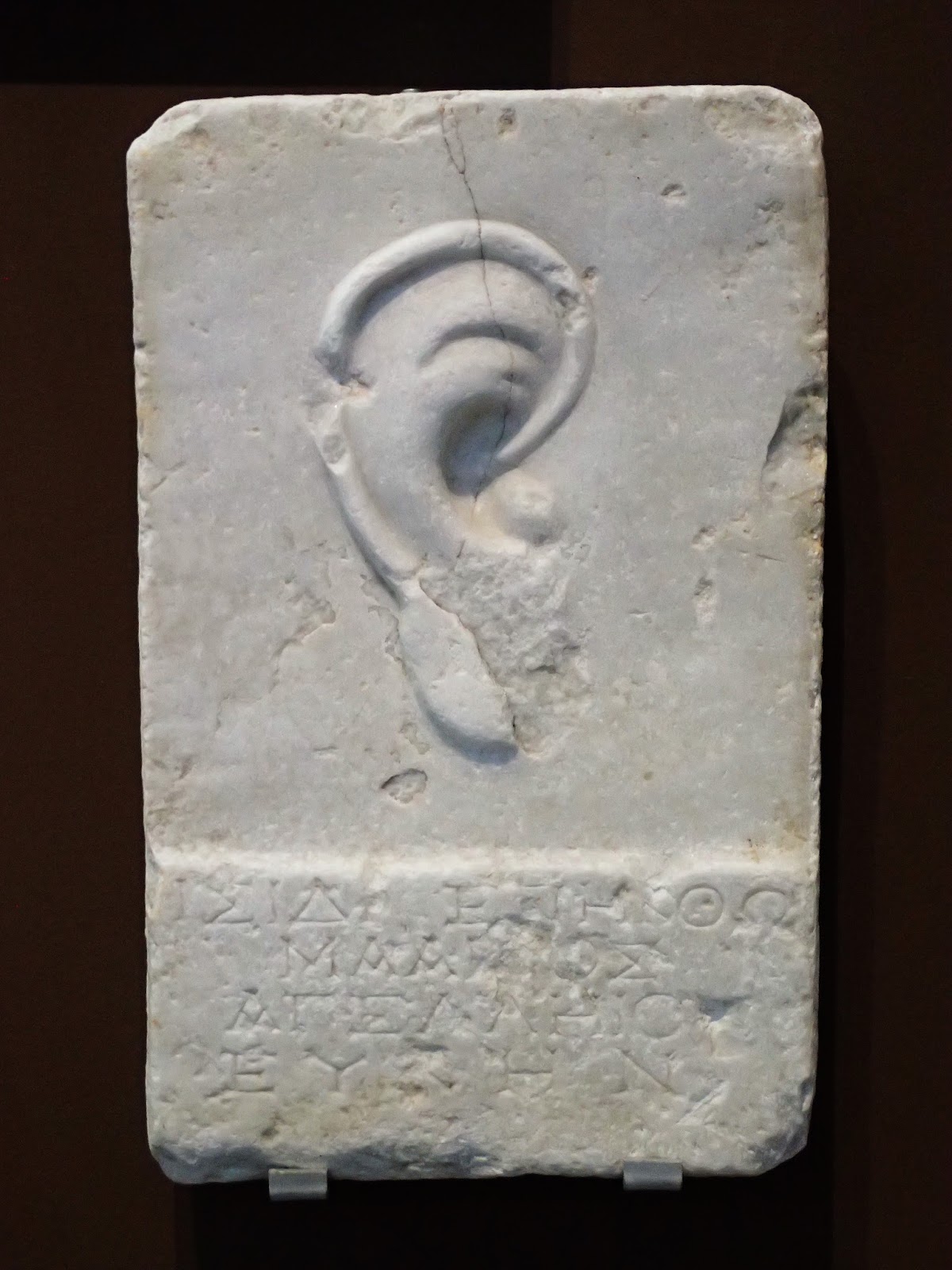
The first engaging thing? These footprints, and... another ear.


The feet are the size of feet, making the ear abut the size of my hand. Right away, they put me in my of a tama, a huge stone tama. Τάμα are gifts to the saints for intervening into our affairs, especially for health, either as pledge, or as thanks. The next day, in the beautiful restored village of Agios Panteleimonas, at the church of the same name and the icon of the same Saint, we see modern day tama:

Some jewelry- bracelets and rings- but also small plates of precious metals with the relief of a whole body or, like these ancient stone tablets, a body part- arm, leg, eye, ear.

Are these tama? Yes, in their way. Were feet healed? No- these are the footprints of the mother and father of a much wanted healthy baby. And the ear? It's not the ear of the giver, but the ear of the God- a way of saying "Thank you for hearing our prayer," again, for a healthy infant. Anyone who has been filled with gratitude for a blessing can understand these at once- the ancient past becomes a lot less abstract.

The same theme of the bond between parent and child in a poignant image. On this grave stone, we see the mother and child separated by death


The scene is full of tenderness- right away you notice the hands entwined, the whole of the toddler's arm not quite the length of the mother's forearm.


Then the small chubby bare feet between the mothers'


In the lower left, a pet rooster? The child reaches high to grasp the mother's hand with the right. With the left, he lowers a biscuit into the rooster's gaping beak.


From the poignant to the joyous- a hydraulis, consisting of a row of 24 pipes of bronze and another of 16, said by ancient accounts to make music that is "sweet and joyful." Also joyful, the account of its finding, down to the very memorable day- a recent one- the 19th of August, 1992


Dion is just the first of our day's adventures, and so we do not see the whole of the park- which is magnificent and you will want to take in at leisure when you visit Pieria, and you may well want to to do. But the glimpse does it. Dion was built here for a reason- the  great and sacred mountain, the bountiful flow of water. Were the wildflowers the same? Likely so. It is Spring, and the statues and ruins are noble and romantic among the lushness of the flowers and the weeds-


This site is very useful for planning a trip to Pieria :
http://visitpieria.gr/


More Pleasures of Pieria:


A moonlight tasting
at Kourtis Vineyards.


Mountain Chic- Dining with 
Zeus at Gastrodromio 
in elegant, laid-back Litohoro.


Read More »

Wednesday, February 17, 2016

Night at the Museum


The most tedious movie I have ever seen centered on the unarguable premise that the Parthenon marbles belong at the Parthenon. Tortured, dramatic speeches were interspersed with scenes of the Grande Bretagne ablaze with molotov cocktails. It was so dull it was nearly treasonous.

Where cinema fails, architecture comes through. Come nightfall, the Acropolis Museum is all poignance and passion.

For those who haven't been, the museum at any time of day is contextually brilliant. Statues and artifacts fill the first two floors. The individuality of some of these is arresting:


They are full of immediacy, intimacy. You know you are before a likeness of someone who lived.

There is a Kore with beautifully plump cheeks and some astonishing traces of blue and red(!)- thrilling to see. A display of the bold pigments that were used literally floods your imagination with color, and you see everything differently (kind of like The Wizzard of Oz). The top floor is stunning- a 1:1 model of the Parthenon, with the original sculptures where they were, and plaster casts of the marbles that are sadly elsewhere where they likewise would be. The initials "BM" are all over the place. As a practical argument, it is matchless. As a contextual experience, complete.

If I'm only at a museum once- just passing through town like say Frankfurt- the joy of seeing is seriously mitigated by the urgency to take it all in. There ends up being more reading and looking than seeing- it is very hard to just be in the moment when you are at last face-to-face with a much anticipated thing seen a hundred times over in reproduction. I'm usually able to give myself over to the experience only when I have the luxury of visiting over and over again. 

The Acropolis Museum is happily such a place. But that is not what made a recent evening there so mesmerizing. The top floor has walls entirely of glass, and as you walk through the magnificently reconstructed ersatz Parthenon, you see the real one close enough to wave to. 

Whether the effect of the glass at night was calculated I cannot say, but it makes for an experience entirely different from the day- one so moving and contemplative as to completely transcend the cultural. In the evening, voices drop as light dims, and a reverent hush falls over the museum. The glow of Parthenon itself against the velvety night sky dominates the room- not just visually, but emotionally. I found I was hardly looking at the sculptures at all, but instead at the glass. The sculptures become, quite literally, reflections of the past, their luminous images hovering in the night sky somewhere between the museum and the place that they came from, like they are reaching out to it. 


Forget what I said about being "in the moment."  There is no moment- time is suspended. And you are just hovering there, like the reflections, between the present and memory.


The  Acropolis museum is at 15 Dionysiou Areopagitou Street (make time for a stroll on this broad, elegant pedestrian promenade that wraps around the Acropolis- you can follow it all the way to Thisseo) and has its own metro stop. The museum has great hours- even in summer, you can enjoy a nighttime visit- it's open until 10 pm on Fridays- For more information, click here. For more information on the unification of the Parthenon marbles, click here.

More things I love to do in Athens:


An Athens weekend of Picasso and Pastis.


A sacred, secret street


Read More »