Showing posts with label Thessaloniki. Show all posts

Tuesday, March 21, 2017

A March of Remembrance: Thessaloniki-Auschwitz


Some time ago I was speaking to an elderly gentleman in my neighborhood. He shared a memory of some older boys he had grown up with. They told him about the day the Jews were rounded up. It was so sudden that they didn't even lock up their houses. The boys wandered in. Of all the shocking things, what struck them most was that the food still warm on the table, and there was no one to eat it.

Sunday was a march of remembrance. We met at Eleftherias square, where the Jewish community of Thessaloniki was gathered before they were marched to the freight cars that took them to Auschwitz-Birkenau. Thessaloniki had been home to the most vibrant Jewish community in southern Europe. At 96%, the loss was the most devastating of all European cities, including even Berlin.

Of the 4% who survived, some emigrated, some stayed. We are left with a few glorious villas, our central market and ferry terminal (by Eli Modiano), the Stein building with its globe on top, looking over the very square the Jews were deported from. We also have a museum, and a lovely Synagogue, but we no longer have any vivid sense of the presence of a Jewish community among us. That is a deeply painful loss to us all.

I thought about that story of the boys finding the food still warm on their neighbors' tables on Sunday morning, as I rubbed a chicken with lemon halves and put it in the oven on low heat with some potatoes. I thought about it because I realized what it meant- that I could leave lunch in the oven, and go on the march of remembrance to the train station, knowing I would be able to come home again, take the chicken out of the oven and have it with my family.


Read More »

Thursday, August 11, 2016

Thessaloniki's Archaeological Museum- the Sacred, the Secular, and the Surprisingly Familiar


Laid-back Thessaloniki rests on the most cosmopolitan pedigree in Greece. The ruins of the palace and Imperial complex of Galerius share the main pedestrian center with the cafes and all night fast food of the students' quarter, and his triumphal arch is everyone's favorite meeting point before a night out. At the beginning of September, we bring our blankets, pic-nic baskets and bottles of wine to the lawns Ancient Agora to listen to bands and watch movies among the ruins. Two of the Mosques of the Ottoman era- the oldest (the 15th C Alaja Imaret) and the newest (the 1898 Geni Tami) have exhibits and installations and art events throughout the year. Old factories have become concert halls and old warehouses are now museums of photography and contemporary art. The past is so incorporated into our daily life you would almost think we don't even need an official museum of archaeology to tie it all together.

But we have one- Thessaloniki's small (compare to Athens', which is tremendous) manageable Museum of Archaeology is crammed with the all fabulous stuff from the rich areas right outside the museum. You can go in knowing pretty much nothing at all, and leave knowing a great deal, thanks to a logical layout and signage with full and fascinating explanations. The public and the private come together to give a vivid picture of Ancient life.

Imperial City-

The Roman empire was vast, necessitating a tetrarchy, with Diocletian ruling the East, Marcus Aurelius the West, and their respective junior emperors, Galerius and Constantius Chlorus.

Torso of Dea Roma- personification of the city of Rome
The Cuirass (breast plate and back plate fastened together) of an Emperor,
with relief of Gorgons and Nereids riding seahorses,
and Dolphins in the waves

We see the (very large) Imperial glory in the Museum's outer room. 

Sacred Life-

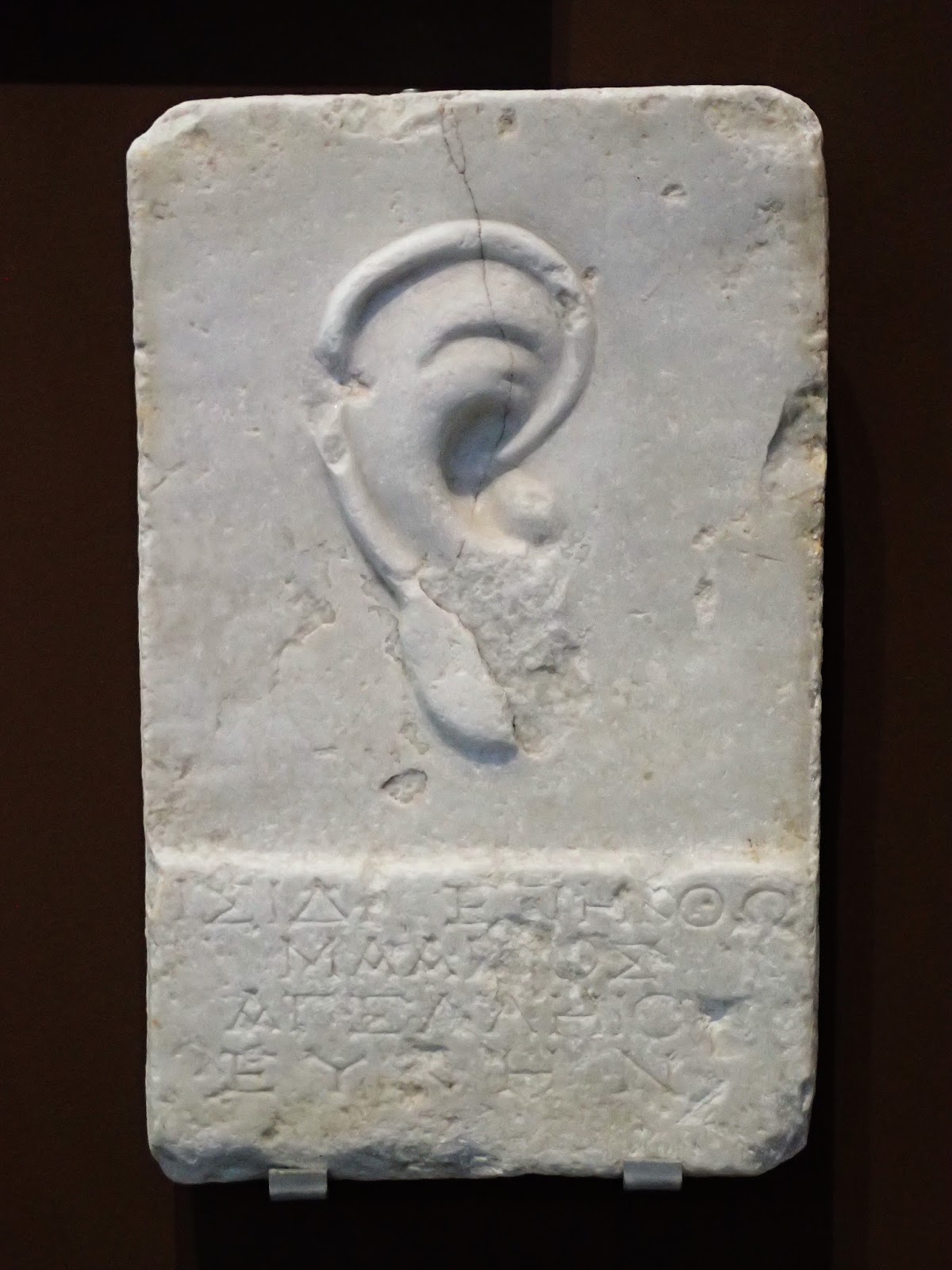
In the first gallery, we are plunged into the spiritual life of the 1st C AD. If you have ever been in an Orthodox church and seen the Tamas on a miraculous icon, it will familiar-


This offering is in gratitude for the Epiphany of the Gods. 

The cult of Isis was wide spread


Here is an Aretology- representing the Goddesse's virtues (Aretes). They were many:


And all things any of us would want.

Sacred meets Secular-

The division of the sacred and the secular was less defined than in our world today. The Pythian games were held in honor of Apollo every four years. People flocked to the city to see not just athletic and musical competitions, but also gladiators, and combat with wild beasts.

These tokens functioned as a free ticket for honored guests
Later on, in the 4th C AD, the Hippodrome was built, integrated into the Galerian complex. It held 15,000 people, coming to see the same sorts of spectacles. These Gladiator and wild beast combats were wildly popular, but also expensive to put on. These were nearly exclusively for the Imperial cult, this itself- the worship of an Emperor as deity- showing the same seamless blending of the sacred and secular.

The mood of decadence and reverence continues. One of my favorite objects is this-


That's Dionysus embracing a satyr, made around the time of the Pythian games. What's that coming from the top of his head? This is a Trapezophoron- a table support(!) that would make a banquet of a bunch of grapes. Evocative table supports such as these have not gone entirely out of fashion:


Of the twelve Gods of Olympus worshiped in Thessaloniki, Asclepius and Dionysus were especially popular- both had tribes named after them. In the case of Dionysus, also a neighborhood-


Our picture of the first centuries AD in Thessaloniki is filling out now, and it is not a dull one- banquets at tables with the tackiest most fabulous table-legs you can imagine, blood shed at sacred brutal games attended by thousands, processions of Phalluses.

Culture-

Not all public gatherings were as sensational- there is also a magnificent 2nd C AD Odeion, still almost entirely intact, at the west end of the Roman marketplace. The aristocracy would gather here for performances of theater and music, and for poetry readings. It was decorated with statues of the muses, and of a wealthy patroness.

The Richness of Domestic Life- 

The picture becomes fuller still with the displays of private and domestic life. Thessaloniki had a great mosaic workshop, and floors of wealthy homes and baths were often decorated with mosaics-


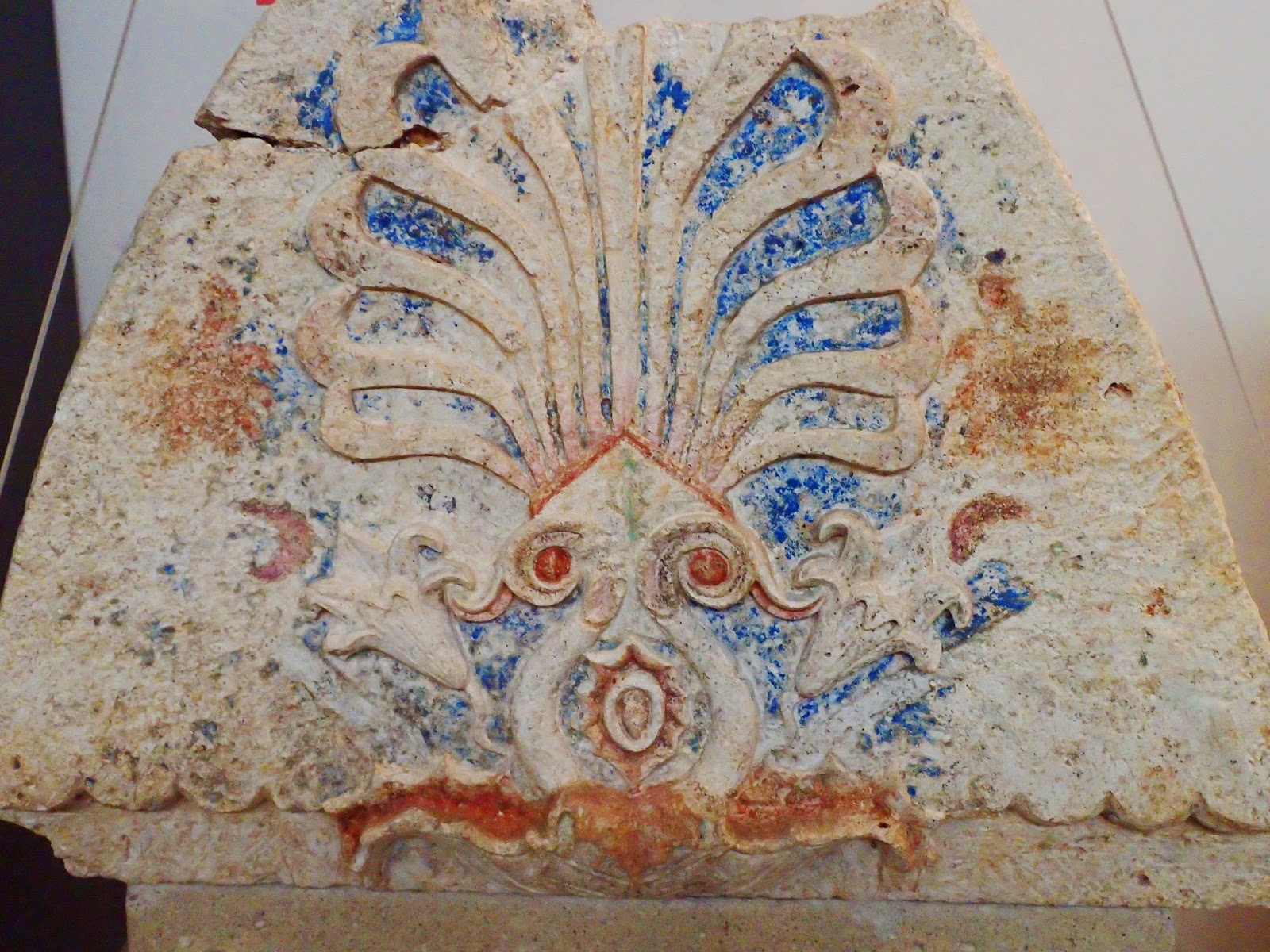
We read of their diet- The Romans favored spices and sauces. From inscriptions we know that the among the aristocracy the diet was rich in variety- fish and shellfish, venison, rabbit, pheasant, and chestnuts, almonds, pomegranates, and figs. We know they held symposia, gatherings of urban elite to exchange ideas, and that they listened to the flute and the kithara, and that the flute- accompanying symposia, theater, and rituals, was also used to give pace to the strokes of rowers and the marching f soldiers. The mosaics have survived, but the paintings have not- walls were covered with frescoes. We can imagine the colors though, because they survive on fragments and on other objects:


We even know they smelled nice, from accounts of "myropoles" (merchants of fragrance), from the beautiful perfume vials found in tombs, along with hair combs, diadems, make-up in small pots. Cura dabeit faciem- "care boosts beauty" (Ovid, The Art of Love) is quoted in the museum's display.

An hour or two will give you an intimate glimpse of the rich and intricate life in our beautiful city of the first centuries AD. You will leave with some understanding of how they celebrated, what they did for recreation, how they dined, what they thought was beautiful, and most importantly, what mattered to them. You may find, as I did, that (excepting maybe the combat with wild beasts and processions with phalluses), it is a very familiar world.

The Museum is open seven days a week, from 8:00 am to 8:00 pm.

http://www.amth.gr/en

More Thessaloniki:


Kinda Blue- Searching for the Roots of Rebetiko


The Lives of Others- Villa Bianca


Open House- Falling in Love with your Hometown
Read More »

Monday, June 6, 2016

Edible Thessaloniki


"Thessaloniki was never a village." 

This is pretty much the first thing out of Kostis Zafeiraki's mouth. He's our guide for the evening on this culinary tour of Thessaloniki's old neighborhood. It is difficult, and actually ultimately unnecessary, to separate food from history or culture. It is in fact not so much isolated flavors, but the idea of edible culture that draws us here, the culture and history of a place that has always been consummately multi-cultural and deeply cosmopolitan.

Athens may be a metropolis now, but it was just a sleepy village when it was liberated. Thessaloniki, on the other hand, was the midpoint between Rome and Istanbul- pretty much everyone was passing through, staying, and cooking. Older residents reminisce- if you heard seven languages just walking down Venizelou, just imagine what there was to eat. 

His next point? Try as they might, international fast food chains do not thrive, or even survive, here. The authentic street food of Thessaloniki - known all over Greece - proves impossible competition. 

The third factor that strengthens Thessaloniki's cuisine- a history of nightlife, and the late night culinary rituals that go with that, one of which, symbolically, is our central stop on this tour.

We are at the statue of Venizelou, right above Egnatia. The market is below us, the strip of all night fast food everything is to our east in the student quarter around Navarinou, but this is the heart of Thessaloniki's food culture. We're near the Roman Agora, the Ottoman baths, and the city's main churches- the area that was always the bustling center, once rich, then in decline, and now pleasantly rejuvenated without being sanitized and gentrified. There is plenty of history, plenty of texture here.

Now, as then, this is a neighborhood with a rich ethnic mix. Our tour starts not at a cafe, or a patisserie, or a restaurant, but at a small corner grocery store, stocked with beautiful products from Poland, Russia, the Ukraine, Georgia. Most interesting- there is a large enough foreign population here for there to be products like Smetana (a thick, soured cream), made in Greece. Come for teas, pickled vegetables, beers in beautiful bottles, waters from distant shimmering effervescent springs, and chewy flatbread. 

Russian chocolates
with a little fairy tale girl on the wrapper
We turn up Venizelou street, shady, grand, not too wide, the main artery of the old neighborhood, then up the hill to the much loved Bit Bazaar- the neighborhood of often affordable antiques. The streets are shaded, the shops are small, and many of them look closed but the owners are having an ouzo somewhere in sight. Maybe here? But this is a new place- a young guy from Ikaria with his delicious recipes, keeping the neighborhood current and adding to its character. Just up the street is a classic Cretan place, owned by a classic Cretan, for a shot of raki and a snail or two- boubouristou (fried with rosemary and doused with vinegar), and some Manteinades- the Cretan short, clever pieces of verse fthat adhere to a certain rhythm (like a limerick, but usually not as dirty). 


There is no one has not been to our next stop- Zarouchas, which is synonymous with Patsas (accent on the second syllable), which is synonymous with a long night out, probably with Rebetika involved. I think this means that no one has not eaten patsas (except for me), but this is not so - asking around, it seems like a shocking half of us have always ordered the creme caramel, the rice pudding, or a chicken soup.


Patsas, of stomach and intestines- chopped fine or coarse, is perhaps not easy to like. It smells strong and very, very earthy- primal, animal earthy. Mr. Zarouchas speaks of the soup's properties- as a hangover preventative, ideal (think of the Mexican menudo)- the dish is rich in collagen, coating the stomach to protect it from alcohol. In addition, it is excellent for the joints, the bones, and the elasticity of the veins. I am sold. 
I will taste it for the first time-


And possibly the last-

Crushed hot peppers- a classic addition-
do not mask all the taste.


Virtuous, but it is sadly not for me.

We stop off at a Salumeria, at the corner of the Roman Agora, for wine and salumia from Italy. Then on to Folia, a half basement on an unassuming, hidden corner.

On the left, the woman who created Thessaloniki Walking Tours
They have some delicious things for us to taste- all very Greek in their ingredients and mood, yet all very novel.

Inventive dishes with authentic roots at Folia

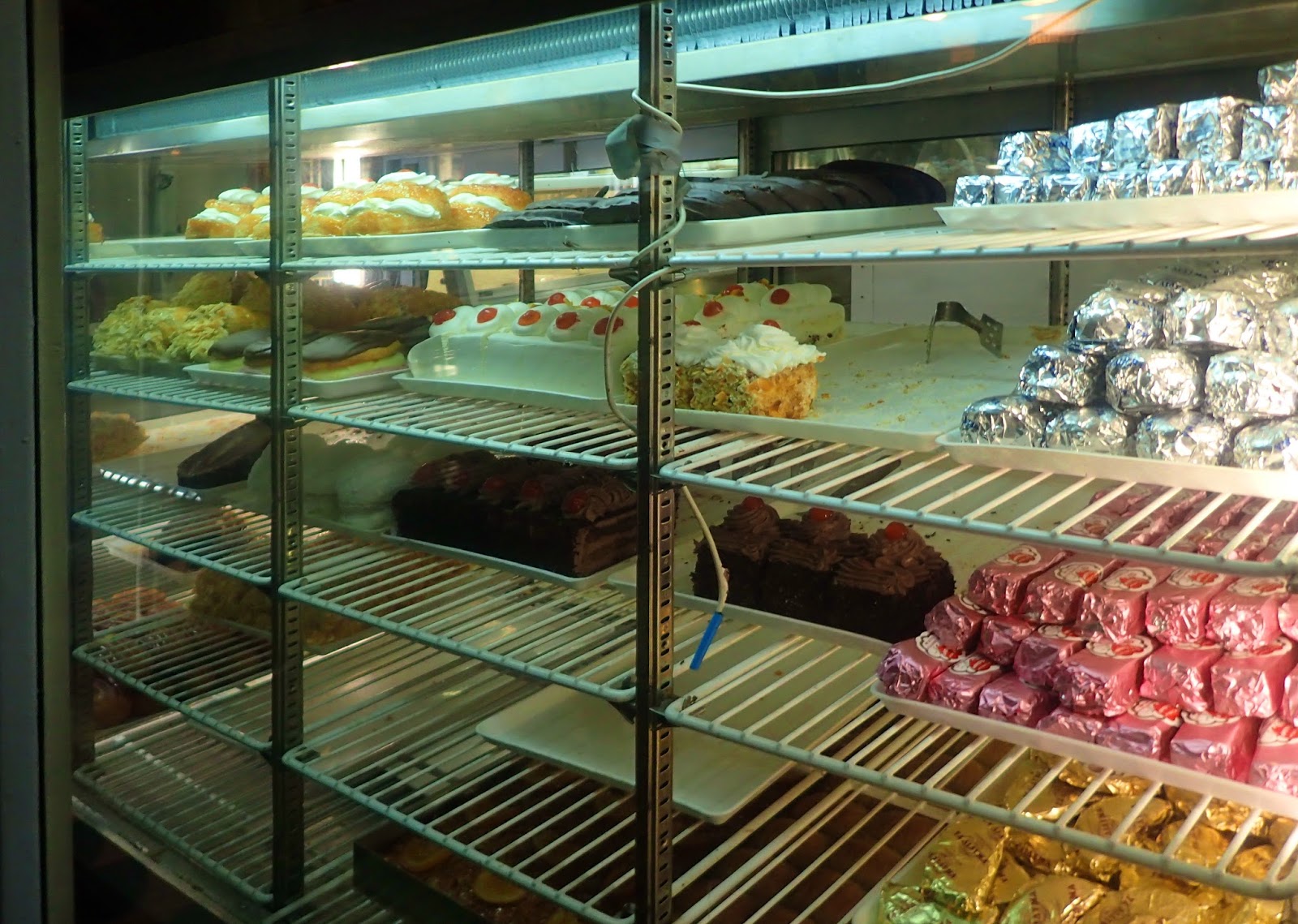
Our last stop is a favorite of all - the unassuming tiny Dorkada- right next to the Alaja Imaret on Kassandrou. Dorkada, family run for decades, is famous for sheep's milk yogurt with a thick skin of cream, and sheep's milk ice cream. The theme? If it didn't exist in 1957, you don't need it, hence the not at all large selection of perfect classic pastries. The ideal baba au rhum, fluffy cream cakes in white or chocolate, and the main syrup pastries all attest that modernity is overrated, sometimes completely irrelevant- a valuable truth in a city with such a rich, edible past.


Fresh, quality classics in the window display case at Dorkada
Thessaloniki Walking Tours make art (really, really entertaining art) out of history, the history tours every bit as delicious as the food ones. So far, I have been on the Rebetiko tour, the Ottoman history of Thessaloniki, been whipped madly around history and the Thermaikos at the same time on a fabulous sailing tour, and, out of town, the Footsteps of Aristotle in ancient Stagira. From each tour, I've come away knowing things that make single every day a little bit more interesting. I adore them. If you get a chance to go on one, do- it will add depth and dimension to your experience of the city.


Kinda Blue- Searching for the Roots of Rebetiko.


Read More »

Tuesday, March 1, 2016

Kinda Blue- Exploring the Roots of Rebetiko


The weather is just right- soft overcast skies that let that quiet kind of beauty flourish. It's no more strange that a prison would be photogenic than that mournful songs would be beautiful. What are we doing at the old prison on a Sunday morning? Musing on beauty, a lot of which came from here.

A group in our hometown (Thessaloniki Walking Tours) breathes the vividness of a fairy tale into the history and culture of our city. The tours I have been on are not so much walking and seeing (plenty of both) as they are like grabbing at a thread and following it somewhere unexpected, unearthing legends and memories along the way, visiting personalities so alive in memory and song that they are only technically departed, telling their stories, and in so doing giving layers of meaning to ours.   

The tour was about a genre of Greek music of deep cultural resonance- Rebetiko, in philosophy not unlike the blues, or American bluegrass, but distinctly urban. Its history is tied to the turmoil of early 20th C Greece, and like most genres with enduring meaning, it's not without darkness and strife. So logically we meet our guide, Tassos Papadopoulos, at the very prison that figures prominently in the culture of Rebetika, the storied Gendi Koule. It's the city's highest point, visible from everywhere, and with a grand vista. This was originally a fortress, part of the Byzantine walls. The main walls of the prison are themselves a rich mosaic- pieces culled from earlier structures- columns, plaques- casually and randomly incorporated into the walls. 


The more recent history draws us here- It became a prison at the end of the 1800's, and was in use until 1989 (!). Everyone on the tour remembers this as a functioning prison, a place of recent, vivid memory. It is hard to imagine that it could fall into such a picturesque state so very quickly. It is a moving place. Right inside the enormous gate is the visitors area. A double screen of mesh separates us from narrow walkways where our incarcerated friends and relatives would be. We could chat through the fine mesh, but not pass them anything- weapons, for instance, or more to the point, hashish. 

Visitors would be where the woman is, taking a photo-
Inmates in the narrow corridor that wraps around.

The Greeks who came from Asia Minor as refugees and during the population exchange brought a love of hashish with them. Illegal in Greece, it is not a jump to see how the prison fits into our picture. Rebetika itself was not in favor for the years of Metaxas- like the Nargile, it was thought much too Turkish.

Art born of melancholy has staying power. Also art born of contemplation. Rebetika casts a little spell- the repetition of a slightly plaintive, hypnotic motif takes hold of you. This is the characteristic "Moumourika," bringing you into the song and moving you forward with it.  A repeated motif makes all the sense in the world. As Tassos points out, in prison you have plenty of time on your hands.
We are crowded onto the platform suspended over one of the prison yards.
That is Tassos at the end of the walkway. Behind him, one of the cell blocks.
While we are on this narrow bridge stretched across the prison yard, Tasso is telling us some lyrics that came from here- Vangelis Papazoglou's song of 1935 "Five Years' Sentence". A man behind me answers him, and the song comes to life as a dialogue, back and forth across the length of the bridge. It is completely spontaneous, not unjoyous- a moment that reflects the depth of the integration of Rebetika into the collective psyche. We go back through the guard house and into the cell block, opened for us. This is the solitary confinement area, picture to the words of a poem about Genti Koule being "the tomb of the living"

We file out, contemplative, and outside the prison gates is a poignant, unexpected moment- two musicians have joined us

Nikolas Vezynias (guitar) and Yannis Eyinoglou (bouzouki) 
and we get to hear "Five Years' Sentence," right outside of the Genti Koule, and it's beautiful.

You could stop here, at this one perfect moment, but we don't- the history of Rebetika takes us through the city's spiritual landmarks.

We meander along the old walls to our next stop. It's near Tzo-Tzo's, a place for smoking and drinking and listening to rebetika songs being played at one table or another, maybe a decade long closed, no one among us has not had at least one memorable (yet blurry) late night here. It had the best view in the city, or at least that was the rumor- years of the rich smoke of hand rolled cigarettes had long blackened it out.

Right where we are standing is a ruin of a house, one of its walls the wall of the city itself. When the refugees came from Asia minor, they took the houses the Turks had abandoned, but it was not nearly enough. The Byzantine walls were covered with shacks and houses such that the wall itself could no longer be seen. A bulldozer finally leveled them one day, but left this one standing:


(Tzo-Tzo's is just out of the frame to the right. There's no more point in photographing it now than there was in eating there then. But it was glorious.) Tasso has lots of stories to tell us- we look over the west harbor, and the cranes disappear as he fills it with beer gardens and skating rinks, concerts, a tram- the pleasure gardens of Bechsinari (in Turkish "Besh" = five, and "Tsinar" the plane tree, so beloved for its deep shade). Just up from this in the marshes was the Bara- an enormous red light district of European-wide reputation. We hear the names of the old "Tekedes"- places to smoke hashish, and houses of cards and dice masquerading as tavernas- one, the Green Mill of the 1960's, right next to us.

As we zig-zag down through the enchanted alleys of Ano Poli, we stop at Tsitsani Square (merely formalizing the well-established immortality of Vassilis Tsitsanis), for some vignettes of his life-


The 16th C Tourbe of Musa Baba
In Terpsithea Square, next to the tomb of a Sufi holy man, we see photos and drawings that bring more of this rich subculture to life- we learn the different types of Magas (tough guy?), their arcane sartorial secrets. We imagine them walking through the square, maybe starting a fight. We learn single words that tell a whole story ("Dervishopaido," for instance- the ultimate compliment for one 'who dances like a dervish').

At the Alaza Imaret, we hear of an illustrious career, decades upon decades on all the continents- a life so full it seems like a myth, then to the cemetery for another life of mythic proportions. In the shade of the fountains by the Rotonda, one more tale- when we walk over to Alambra to hear more Rebetika, beautiful Rosa Ashkenazy still dances in our heads.


Thessaloniki Walking Tours cover many themes, and are also given in English. We have 17 centuries and three empires worth of history in Thessaloniki- they weave it into some fascinating, lively pieces. Visit their site for details-

http://thessalonikiwalkingtours.com/home/

You can hear live Rebetika several nights a week at Alambra, Phillipou 80, near the Rotonda.

https://www.facebook.com/groups/476296699057958/?fref=ts


Read More »

Thursday, November 26, 2015

Open House- Falling in Love With Your Hometown.


Travelers strive to experience destinations like a local. Open House encourages us in the very opposite - experiencing our hometowns with the fresh and appreciative eyes of a tourist. It's an inspiring approach to everyday urban life.  

For my Thessaloniki Open House agenda, I picked places not ordinarily accessible -  and that's the beauty of it. Of the nearly 70 spaces that had opened their doors, many were offices and residences. Having just visited the city's more officially historic buildings for some articles I am writing, I decided to focus on places that you can usually never see, unless you are really quite ballsy and fresh.

I did start with one big name building that is rarely open to the public- I remember seeing the Villa Petridi in a state of ruin, just after the courthouse off to the right as we would turn to go to Mylos. It was easy to spot- a shamble of a splendid three story Art Nouveau house all by itself among sad looking office buildings from the 70's. The view from the Villa itself was all industrial romance- the high red brick walls of the working harbor and the cranes peeking above. You'd go by the villa and say "Wow they should fix that beauty up!" Now I kind of wish they hadn't. 


Home depot stencils run amok, and a gracelessly interrupted pattern. The floors shone like a diamond. The tales though- imagining the brook running by and the tram lines intersecting, that was nice. A not at all surprising truth-

Ruin is imagination's best companion.

Well, it was nothing but nice surprises after the Villa Petridi:

Some lawyers had generously opened their offices; it used to be an apartment, or perhaps one could say, the apartment.


The corner penthouse of the prime and first of Aristotle plaza's defining buildings was worth seeing. Replete with charming features, like the dramatic bathtub niche:


But of course everyone's favorite was this, the Clark Kent of architectural devices:


(Residents of Thessaloniki who are good at 3D puzzles will know that, logically, on the other side of this bookcase must be Pavlou Zanna screening room of the Olympion cinema. It used to be a theater for live performances, which means that this bookcase covers the opening that was once the family's private box- complete with bedrooms, kitchen, and bath!) 

The terrace was every bit as defined- and refined- as the interior:


The industrial lands to the west have the slaughterhouse, and the waterworks. The slaughterhouse, like the villa Petridi, had been sanitized of all atmosphere (but not of imposing symmetry):


Less sanitized was the guard house:


And best of all was the unsettling collection of busts, stored without name or ceremony at the lot's edge:


Pensive and timeless- to say nothing of eerie:
dismembered figures on the grounds of the slaughterhouse
Why is Poselli such a well-known name in Thessaloniki? These days the mad good pizza, more delicious still for their impeccable taste in choice of name- the architect Vitaliano Poselli, of the Arcade in which the stellar pizza oven is housed, and many of Thessaloniki's most elegant Jahrhundertwende buildings, among them the Catholic Church, of 1897-

This splendid Campanile once towered
over the neighborhood.
- a little piece of the West in our city of the East. (More Poselli buildings soon- a tremendous presence in our urban landscape.)

The 14th C Byzantine Baths of Koule Kafe (a UNESCO world heritage site) were ultra-photogenic. Or at least I can only imagine- photos were sadly prohibited (until the restoration is complete). Like at many sites of historic and archaeological interest in the abundance that is Greece, there was a lot of "stuff" that the rest of the world would probably have in a museum. Here is some of it-

These intricate indentations-
not unlike the muqarnas of the nearby Alaja Imaret-
 seem to anticipate the Islamic architecture
that would shortly be marking the city.
Corinthian fragments like lions' feet.


A curiously modern motif.
The last notable building was commercial- an Art Deco gem with an atrium, metal elevator cage, grand staircase, and huge central common areas:


Design Rorschach test:
Our guide said that rumor has it that this eagle motif
is a remnant of the German occupation.
A lady in the group proposed that, in fact, it also resembles a pair of scissors-
entirely appropriate to our textile district.


And after that, an unexpected treat: from the roof of a soon-to-be Bed and Breakfast, a rare view of the interior courtyard of the "Alkazar" (the Hamza Bey Mosque):


Do you love the variety of marbles in these columns?
Perhaps, like those in Agios Dimitrios, they are "recycled" from
Roman or Byzntine structures.

The two days made for a rich collage of images- spaces both commercial and private, sacred and secular, raw and ornate, and, this being Thessaloniki, several centuries' worth. It was a special occasion, but exploring doesn't have to be: that is perhaps the point of Open House- it wakes you to the architectural variety and beauty that is around you every day. I resolved to be more of a tourist in my home town (and maybe a little more fresh)- an easy resolution.

Read More »