Showing posts with label ouzo. Show all posts

Thursday, March 16, 2017

In Volos, Drinking Tsipouro is an Art Form


I love it that the vagueness, the occasional freewheeling chaos of our little Mediterranean paradise disappears just where you'd expect it the most. It may be pandemonium at the supermarket or the post office, but never where you have a drink in your hand- (see Mastering the Art of Greek Drinking for more on this particularly useful aspect of Mediterranean finesse)


Alcohol in Greece is always accompanied by food (and more importantly still, by companions). At a classic kafeneio, an ouzo (an art form of Lesvos) is called an ouzo mezze- meaning the glass of ouzo very often automatically comes with a small plate of bites, kind of like a Greek Tapas. Otherwise, there will be "ouzo plate" on the menu- a oblong metal dish with a surprise mix, but almost always including various cured and salted fish that are the perfect counterpoint to the sweet anise kick of a cold and cloudy glass of watered down ouzo.

In Volos, the combination of spirits and tastes has been elevated to an art form- a perfectly curated experience in which nothing is left to chance, or even choice. In Volos, Ouzo gets an upgrade to Tsipouro, ouzo's high octane cousin- made not with neutral spirits like ouzo is but rather with distilled grape spirits (like grappa). Tsipouro is served "με" (with) or "χωρίς" (without)- this being anise and often other secret botanicals to round out the flavor. You definitely want "με"- it's strong and complex, but just let it have its way with you, and you are in for a great evening.

Spyrou Philoxenia arranged a trip to gorgeous Pelion for our Travel Bloggers Greece anniversary last month. On our last day, we got to experience the classic Volos Tsipouro ritual. Grigoris Fanoulas of Let's Go "live like local" experiences, invited us to Lepi ("fish scale"), a Volos Tsipouradiko right on the water. We loved the modern decor, we loved the classic dishes, but most of all we loved the element of surprise.
Grigoris of Let's Go explains the ritual
These bottles were wasted on Mei Mei- she had an orange soda.
At this as at all Tsipouradika, the tsipouro is served in individual single-serving bottles. With each bottle comes a plate- the first plate with the first bottle, the second with the seond, and so on, such that if you are two you have two different dishes- the first and the second- and a progression of dishes; if you are four, the third and fourth as well. The dishes are planned to offer variety, balance. They progress to the more elaborate (but, octopus is frequently the first or second dish), so to have the complete experience, you need to make an evening of it. The price for round one is the same as the price for round eight, regardless of the dish.

At the Symposia of Ancient Greece, the wine- a much heavier drink that our wine today- was mixed with water in a krater- a handsome, shallow, footed vessel. The ratio was usually part wine to three parts water, but the host of the symposium was in charge of the ratio- in charge, effectively, of the strength of the drinks.


The tsipouradiko experience is like that- letting someone else curate your evening. The portion size- larger than a tapas, slightly smaller than a regular taverna order- is perfectly calibrated to be the ideal amount of food to temper the effects of the alcohol, but not temper them too much; you should gradually reach a pleasant plateau, and stay there. This is not a pub crawl, or a tailgate party. It's the successful intersection of culture and experience.


Salty fried in the shell Crab are better than any dessert
Smoked fish of every kind makes a perfect Tsipouro meze
I ask Grigori about the ideal experience, and he doesn't miss a beat: "Five tsipouro each over a period of three hours, for locals." No hesitation. I'm loving the lack of ambiguity, although that could partially be the second little bottle and the fried in shell crab. They offer the experience as one of the "live like local" activities of their company- some people may be shy about diving right in: "For visitors, we recommend three tsipouro each, over a two hour period." 

The best part, of course, is the conversation- over three hours, you can explore topics with leisure, punctuated by the clinking of glasses throughout the night.

Volos with its port and sailboat harbor is a short and pleasant train ride from Thessaloniki, and a beautiful city. A visit to a Tsipouradiko is all pleasure, and all culture-

Try Lepi:

https://www.facebook.com/pages/Lepi/896998330365040

And live like local for creative, authentic cultural experiences:

https://www.facebook.com/livelikelocal.gr/

More on Pelion:
 
Rainy Day Pleasures in one of Greece's loveliest regions


The Ultimate Greek Weekend- from "Mama Mia" beach to a snowy mountain.

Read More »

Monday, May 30, 2016

The Culture of Ouzo, Lesvos Style


If your drink doesn't have a learning curve, 
it might be the wrong drink.


Ouzo is heaven... eventually.

A rough start-
Most of the things I like best in life, I at first didn't really like at all. 

Many people's first introduction to ouzo abroad is, well, unsubtle. If you saw My Big Fat Greek Wedding, you'll remember the scene where the uninitiated waspy couple down a few straight shots of ouzo that set their heads spinning (it can't possibly help that people keep shouting "Opa!," which is really disconcerting, and almost never happens). With a heady anise and alcohol kick, your first straight shot of ouzo shocks the palate and stuns the mind. Sadly this is how it is usually introduced abroad- a hospitable welcome, downed on the quick. But ouzo is all delicacy and finesse, and certainly nothing hurried about it.

My introduction to ouzo was not first hand, and technically was not ouzo. My parents' first date was a byob college party. My father, wishing to appear sophisticated, brought a bottle of Pernot (for our purposes here, let's call this a French ersatz ouzo- a spirit with dominant notes of anise). He had no idea what it was. They had it straight. The intensity of its memory became part of our family lore.

Without a rough start, the mystery of ouzo would not qualify as a secret. I like secrets.

A little magic-
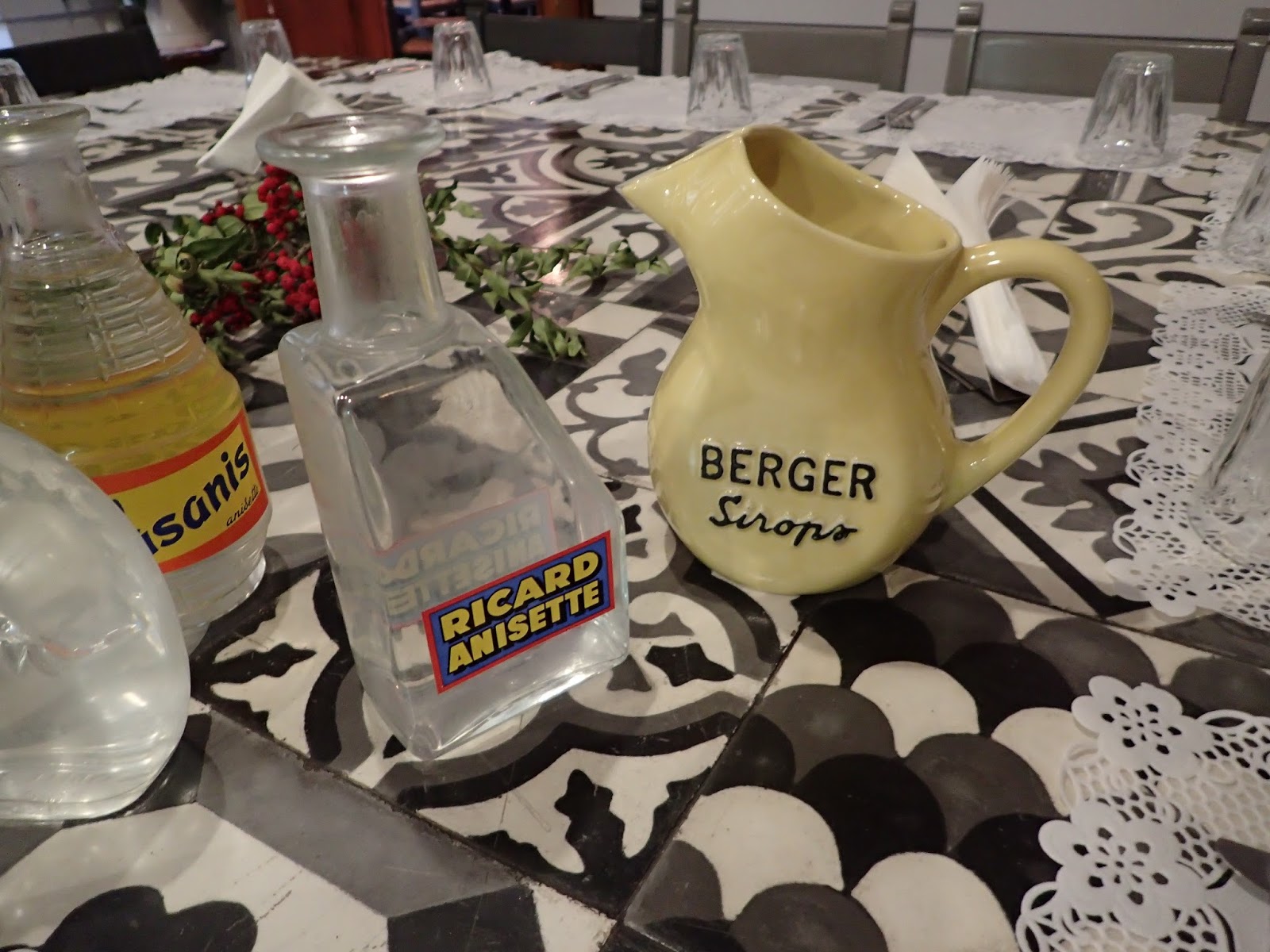
My second introduction to ouzo was, again, technically not ouzo, but it did start to make a lot more sense. We lived in Paris one summer and often went out for an aperitif before dinner, whether were were dining out or at home. This hour of Pastis enchanted me. More delight?- the drink's magical *transformation from clear to opaque! When you would pour in some water from the manufacturer's carafe,

A selection of classic Pastis carafes at Chez Violette, my favorite restaurant in Exarchia
it would make clouds in the drink that swirled and spread like when you pour cream into iced coffee. The aroma changed from intense to... mysterious and beguiling. It's a nice ritual, the dilution- a moment of alchemy, a small magic.

This experience, combined with adopting the Greek habit of practically never having alcohol without a snack, placed me higher on the curve. I thought. Then I visited Lesvos, ouzo's spiritual home.

(There is no learning curve in Lesvos for ouzo- they were born with the subtlety needed for maximum enjoyment. Happily, they are generous with their knowledge.)


A tour and tasting at the EVA distillery deepened my affection for the drink.
Why ouzo is the perfect drink-
The grand culture of ouzo is a delight to explore, but first it is helpful to know some fundamental principals of socializing at the Greek table. These are a topic all their own- Mastering the Art of Greek Drinking explores the refined practices that can (and probably should) be adapted to any table. Ouzo lends itself particularly well to the practice of Greek drinking etiquette.

Why ouzo is the perfect drink (again)-
An authentic experience of ouzo is a revelation, almost an epiphany. The truth of things is that there is no subtler drink- imbued with grace and finesse, regulated by ritual and custom, beautiful and softly cloudy in its perfectly proportioned glass, enhancing every bite, adorning every word. You could drink this all afternoon or all night, which is good, because you will probably have to: Greeks and their fortunate guests spend a long, long time at the table, and not just on weekends and special occasions. This brings us to the first of ouzo's virtues-

Flexible and forgiving:
Ouzo is very frequently diluted with water. You can make a blend that gives you just the faintest glow, and this in turn makes it possible to extend the hours of conviviality. It also ensures they have no unwanted affect, so they can be enjoyed as often as the occasion arises (in summer especially, that is a lot).

Lesvos' neighbors also make ouzo- 
here, with mussels, in Exarchia

Lively-
I have absolutely no medical evidence- none- for this claim. But wine, which I like very much and is so nuanced and lovely and complex, very often makes me sleepy, and ouzo never does. It's a lively, inspiring drink. Elena's fresh hashtag #theouzoeffect sums it up- only good can come of having a glass of ouzo.

Canned dolmadakia and packaged taramolsalata are elevated by a glass of ouzo
A marriage of perfection-
Mezze- small plates of savory bites- are popular from here and into the east. They represent the flexibility, resourcefulness, and above all extreme hospitality that characterize this entire  part of the world. A table of mezze gives a sense of plenty, whether it is a great variety of seafoods, or a puree of dried pulses with some herbs and oil and a dish of olives. Fresh, smoked, and salt cured fish and seafoods are a central part of Greek gastronomy. So too are salty cheeses, spreads (taramosalata, tzatziki, melizanosalata), and of course olives. The soft, sweet flavor of anise is in perfect balance with the bold and salty flavors of the Greek palate. Anise is also considered a digestive- this is a drink made for food.

What we learned in Lesvos-

*"Πάμε για ενα ουζέλλη;"

All the social values that give ouzo its relevance are here in abundance. Ouzo itself flows in abundance- there are 56 types of ouzo distilled on the island. Many of the distillers came from Asia minor, and brought their recipes with them when they settled in Lesvos for a new life. More to the point, the character of the island lends itself to the drink.


From top- our cheerful party, a hard sheeps' milk cheese (made by Stratos' mother) in oil surrounded by mirabelles, 
the delicious island specialty "Salamura"- feta in a bath of sheeps' milk yogurt, 
various mezze- the salamura, beets, fava, and smoked fish- 
rich and salty flavors are particularly fine with ouzo.
Giorgos, our host, brought us to a mountain village to have lunch with his friends Maria and Strato. He explained how pleasantly the winter passes. In the summer, days are long, and filled with productivity, be that in the fields, or in the many jobs that revolve around hosting visitors to the island. In the winter, there is less work, and "...the nights are long. Friends, music, and conversation over an ouzo- these fill the long nights of winter with joy."

How to drink ouzo-
Until the very day before my trip to Lesvos, I was having ouzo with water and ice. Only once were we even brought any ice in Lesvos, and that because we were obviously not from Lesvos. Why no ice? If you put an ice cube in ouzo you will notice sparkly flakes collect around it. I always liked these. But, they are said to cause a hangover. Ouzo is drunk neat, with water on the side, or diluted with cold water.

I asked Giorgos how we serve ouzo. All the ritual of the Greek table is observed, and every bit as much toasting, if not more. The only exception- when drinking wine or tsicoudia, we may top up the glass of our neighbor if it is running low. Many people drink their ouzo with water though, and they have their own preferred ratio. Topping up their glass will throw that out of whack- wait til your friend's glass is empty to fill it again. 

Our favorite toast-

"Και εις άλλα με υγεία"


"To others (other toasts, future glasses of ouzo) in health." Even in just the five days I spent in Lesvos, I found it easy to give myself over to the benevolent hands of fate.

More on ouzo, Lesvos, and lifestyle:


Lesvos and the Essentials of Ouzo


Falling in Love with Lesvos


Master the Art of Greek Drinking for a lifestyle upgrade


Molyvos is the Greece of your Dreams

The best place to be for exploring Lesvos is the central charming harbor town of Skala Kalonis- stay with Maria and Giorgos at Natura Studios


* The aromatic oils of anise are soluble in alcohol, but not in water- that is why it goes all cloudy and soft. 

* "-έλλη" (elli) is the island's diminutive, like "-aki" elsewhere in Greece. This means- "Shall we go for a small ouzo?"


Read More »

Thursday, May 19, 2016

Molyvos is the Greece of your Dreams (and hopefully, your best self).


When you think of your perfect, ideal Greece, you're probably actually thinking of Molyvos, home to all of Greece's perfections, double distilled. This is the jaw dropping gorgeous sun soaked Greece of turquoise seas and bright painted boats, tavernas with checkered tablecloths and octopus legs hanging from fishing line, white-washed stairs, roses and bougainvilla climbing trellises, villages on hillsides, the Aegean glimpsed like a dream though an open window.


Picture postcard picturesque perfection. Our first glimpse of the city? Giorgos our host stops the truck for us to get a shot of the city because we are oohing and ahhiing 


There it is- a seaside fairy tale with a castle on top. This is our first morning in Lesvos. Two hours ago we were drinking a coffee on Aegean. This is surreal, and it's not like we're not used to beautiful places; we all live in Greece already, and write about travel (Travel Bloggers Greece) and culture and beautiful experiences. None of us have been in Molyvos and we've all been looking forward to it; it is a fabled place. 

A couple more turns in the road and we are there climbing out of the truck and wandering up the cobblestone paved hill, shaded by an arbor, and lined with cafes and shops. There is not a hint of touristic kitsch anywhere- just beautiful, elegant, handmade things-

Chic Botek- designed and made right here


We are on our way to visit the Molyvos Tourism organzation and meet our, I'm going to say, ambassador- Gabriela Vati. she takes us into her life for the afternoon, and it is a very beautiful life. We stop into the church- Agios Panteleimonas

A light, neo-Baroque- common to the island- mood makes for a joyous interior
Then we go the main plateia ("square"), shaded by a huge Plane tree, and circled with grand houses, Gabriela's florist shop, and a supermarket (island style)

This dreamy mansion is *rentable by the night.


(The florist shop, the mansion you can stay in, the views, if this puts you in mind of getting married, Gabriela can arrange everything- she has started Menta Weddings for the people who come from all over to celebrate here, the most beautiful place they have ever been). Gabriela tells us about her beautiful town as we go down the hill. We are at a harbor, and it is all charm. If the sun in Molyvos had a flavor it would be sweet. It sugarcoats every surface- the cobblestones, fishing boats, sparkling sea, your shoulders. You forget what it was ever like to be cold. The sea is turquoise at the small beach, but even here at the harbor- deeper teal- you can make out every stone on the seafloor, each school of fish. The fishing boats are brightly painted, each its own way, and named. They strike the perfect balance between story-book and serious work- the fanciful colors, nets neatly bundled.


St. Nicholas (patron saint of sailors and fishermen) watches over the harbor from a modest church bathed in the crisp light of the sea. 

The water's like glass and you sigh longing to be in it, or at least on it. The only thing missing is a handsome, wind-burned captain to take us for a spin in a beautiful boat. This is where the day slips from perfect vacation to not completely believable perfect fairy-tale. Before I know it, there's the strong weathered hand of captain Nick pulling me aboard.


Nothing like the sea to make you hungry. We dock at the promisingly named "Octopus" which has octopus hanging right outside, which we have with ouzo, which is essentially a sunny Lesvos afternoon in a glass. (more about ouzo here).


We are having a a fantastic time in Molyvos- aesthetically, this is the quintessential Greek experience. But like they say, beauty is more than skin deep. We have been invited to write about the island- it has been in the news constantly- not because of its astonishing perfection, but because of the thousands of refugees who have landed, and sometimes been washed up on, its beautiful shores. This has kept tourists away, which is a shame, for two reasons: The first is, that the situation has changed- the shores are quiet, and the refugees are sheltered and as safe as such a terrible situation allows. 

The second reason it is a shame that tourists are not going to the island is a lot more compelling: When we think of Greece it is not just a place but an ideal- we are inspired by the sea and the sun and the cuisine, but also by the values we ascribe to Greece- honor, hospitality, generosity. All the nights we would watch the news and see wet and hungry families on the shores and saying how sad and want to do something? These are the people who were going to the shore to help them every day, bringing water and food from their homes, clothing, sharing whatever they had with grace. We basically only know this from the news. They brush it off- Gabriela said "We just did what anyone would have done." Lesvos embodies not just the beauties of Greece, but also the ideals.
For this reason alone, I cannot think of a place I would rather visit. 

More on Lesvos:


More on ouzo:


Ouzo of Lesvos and touring the Eva distillery


and:


Mastering the Art of Greek Drinking-
Embracing Dionysus with Style and Grace


The Culture of Ouzo, Lesvos Style.


* Like the mansion with the palm tree? Contact Gabriela at Menta- it belongs to a friend of hers. This is not a sponsored post. It's just something I would love to do myself someday, get all my cousins together and have a holiday in a mansion on a gorgeous island. It was extremely affordable.

** Warmest thanks to the taverna Octopus for hosting us- It was truly the perfect meal. 
Read More »

Saturday, May 14, 2016

Mastering the Art of Greek Drinking


Our happy corner of the Mediterranean has a reputation for Dionysian chaos. This is just a half-truth. A Dionysian joie de vivre does set the tone of everyday life- with that, there is plenty of drinking. But none of that drinking is chaotic. Drinking, in fact, is probably one of the least chaotic things about Greece. The relationship to alcohol here is refined, elegant- a defining aspect of culture. What makes it special? 

In Asmomatos, Lesvos, with friends.
First, this is a sociable culture, and drinking is a sociable activity. Drink is parallel to conversation, not an end in itself. As this is Greece, there will probably also be something to eat- our next point:


- Traditional Greek drinks- raki, tsipouro, tsicoudia, wine, retsina, and- perhaps especially- ouzo- are classically enjoyed with food. Why do I say especially ouzo? It's very name is linked with food- an Ouzerie is a type of restaurant where you have a variety of small plates with ouzo; ouzo mezedes are the meze (small plates) that are made to enjoy with ouzo. Ouzomeze (spoken as one word) is your order in a classic Kafeneio- where a glass of ouzo automatically comes with a small plate of bites (an olive, a smear of tarama, an anchovy... ). This also applies to international drinks- cocktails. Cocktail bars generally have no kitchens, but the snacks they bring- even if just mixed nuts and potato chips although very often there are cucumbers, carrots, olives, cubes of cheeses, breadsticks- are better and more plentiful than you may be served in other countries. 

- Alcohol is not stigmatized and marginalized in Greece. Children can be sent to the kiosk for cold beers if we run out during a barbecue. My daughters had wine on a field trip to a vineyard in grade school ("Oh, not much mama- just a sip."), and they have beers with their teachers on the weekend trips they take in High School. The happy result? - a slow introduction to drinking, in a social context. You may see a drunken teenager in Greece, but not often, and rarely are they dangerously drunk. It just doesn't have that juvenile thrill of the forbidden.


-There is no "open container" law- you can get a whiskey at the outdoor cinema, and you can get a cold bottle of retsina and some plastic cups at the kiosk, and sit on the ground at the waterfront. A group of university students enjoying the sunset together this way is a happy sight.

-Lastly, and most importantly, it never seems to bring out the worst in people. Convivial, jovial groups get a little bit loud, and there is more laughter. As to fighting and public vulgarity? - very, very rare. 

(Amid so much to admire, one improvement is vital- both education about drunk driving and enforcement are deeply wanting.)

The nicest part about drinking in Greece is that the easy flow of alcohol, the nearly constant raising of glasses, is anything but chaotic. There is order, and grace- custom continually reinforces drinks' place of bringing the group together, of commemorating the moment, and celebrating life.

Mastering the Art of Greek Drinking:

- Whatever the drink (wine, tsicoudia, beers, ouzo), you don't just start drinking. 

- Don't worry, you will not go thirsty. After everyone's glass has been filled, there will be a general "γιάμας!" ("our health!") to start things off. Thereafter, sip from you glass as you like.

- Well, not exactly as you like- there will be some mandatory drinking when a new round of toasting is occasioned, such as:

  • If anyone new joins the party, we will all toast afresh when their glass is filled for the first time.
  • Whenever anyone's glass is refilled, it is not uncommon for them to toast with the fresh portion. This happens a lot- glasses are generally small, and so refilled often, perhaps to this very purpose. You can fill your own glass, but fill the empty glasses of your neighbors first. Who fills whose glass? Just as you wish, but it much follows the pattern of society in general- gentleman often fill ladies' glasses, and you fill the glass of your great aunt.
  • From time to time, someone will simply be seized with the impulse to toast. This is particularly the case at a large table- a party of six are often engaged in the same conversation; a party of seven or more, you will likely be engaging with your closest neighbors. A toast reunites the group.
  • Is there a happy event coming up? There will be more toasting still.
  • Is this all sounding like too much? By all means, do join in every toast. Just don't take a mouthful- wet your lips with the glass.

(As glasses are raised in one of these impromptu toasts, there is a quick scan- any glasses needing a refill get one now.) These occasional toasts bring a large group back together. Although rising from your chair to chime glasses with someone otherwise out of reach is not mandatory, it's very much in the spirit of things to do so, at least some of the time. At other times you meet the eyes of those seated far away and raise your glass to them. 

Sound complicated? It quickly becomes natural- in fact, it is difficult to unlearn. Visiting San Francisco, I was half through a festive meal and parched for my first cool sip of white wine. But what was I to do? No one had toasted yet, and I was not the host and also the youngest by a generation. I looked around and saw everyone drinking at their own pace. Much as I wanted a sip myself, taking it without ceremony did seem unhappily occasionless.


That is perhaps the the key to letting just the right amount of Dionysus into our lives- making an occasion out of every day.

For more on Greece's iconic national drink, read about:


The Essentials of Ouzo


The Culture of Ouzo, Lesvos Style
Read More »